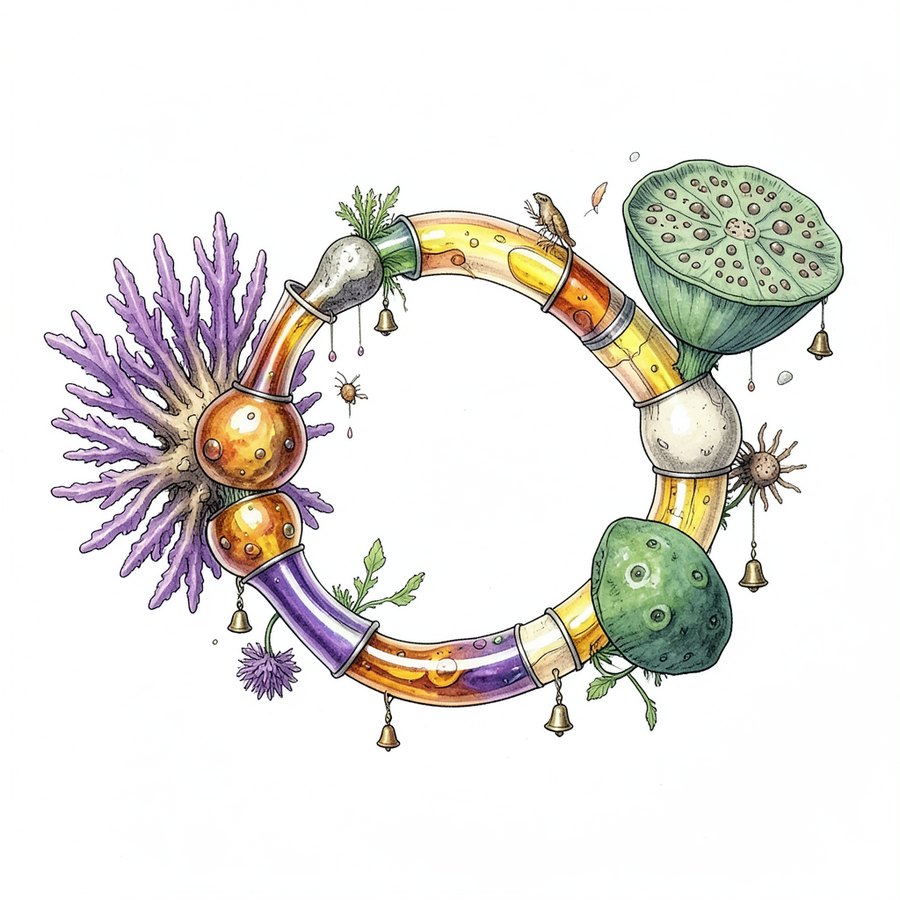
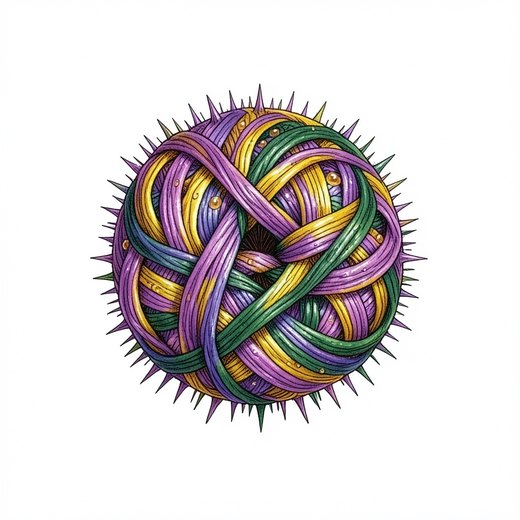
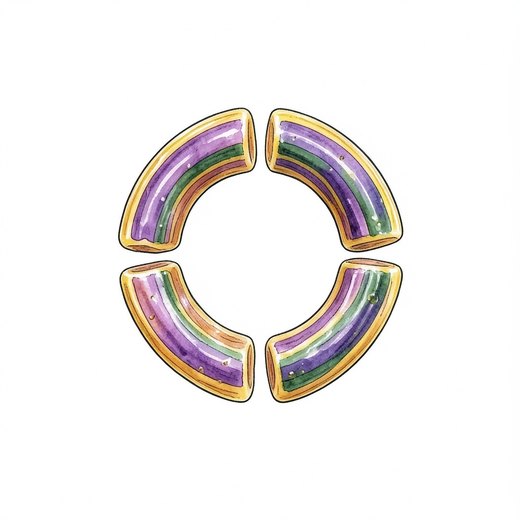
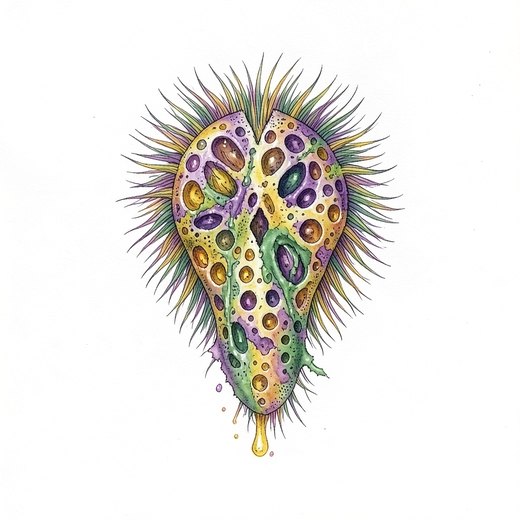
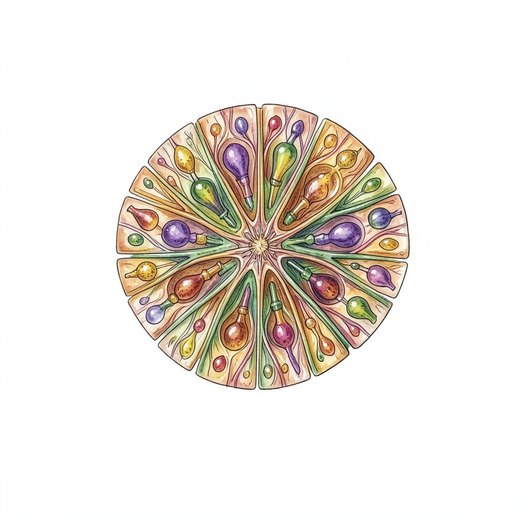
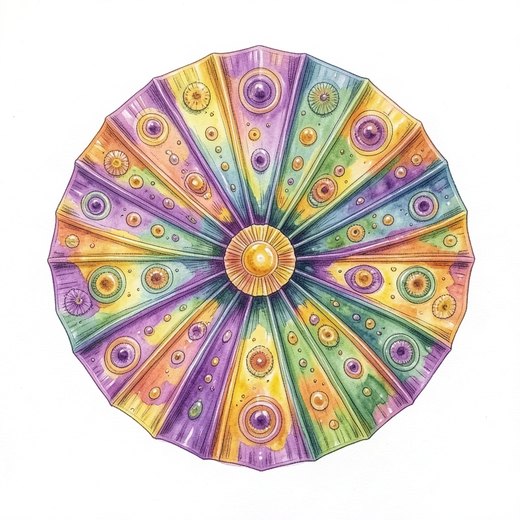
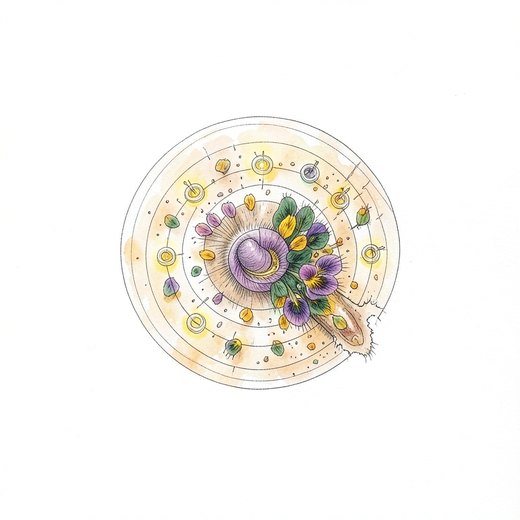
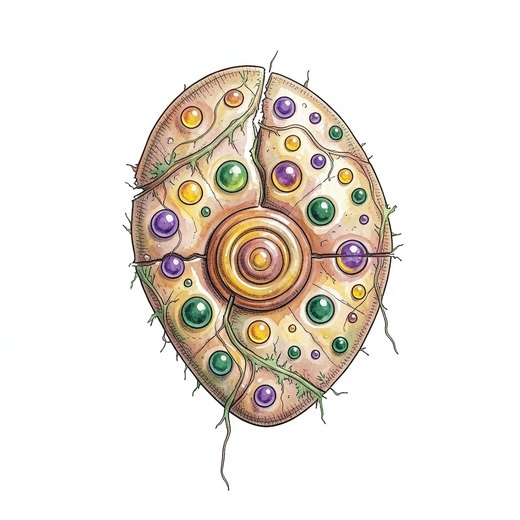
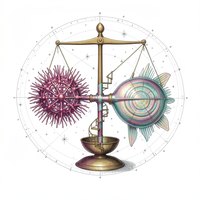
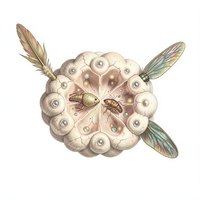
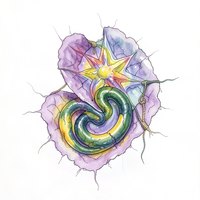
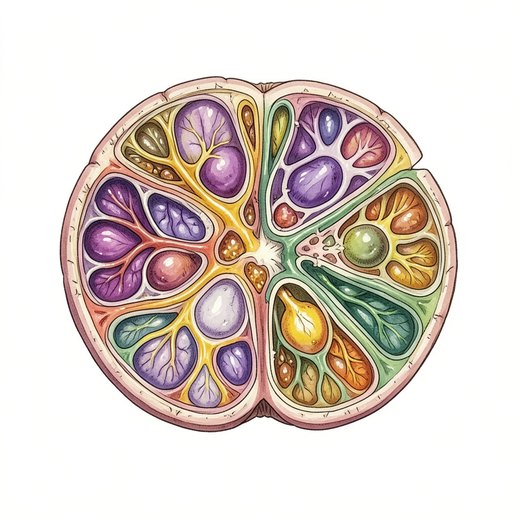
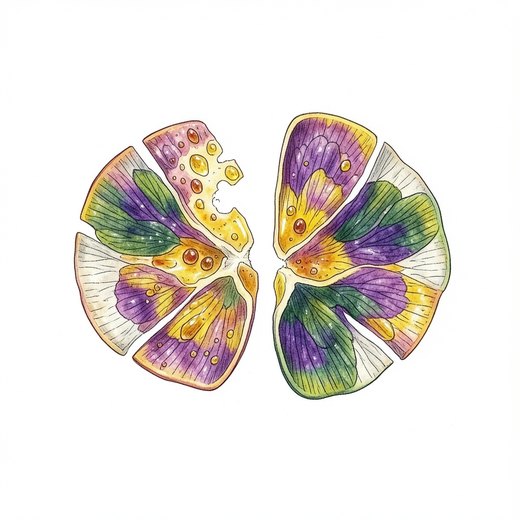
Plate LVIII. Synmnemon calendaris, the whole specimen.
When a whole people remembers the same past on the same day, each one's memory is pulled toward everyone else's, so a feast day makes many memories into one, and between feasts they drift apart again.
A people's past is the one it remembers on the same day.
behavior Many small forms that drift apart over the year and draw together into one shape on a single bright day.
provocation
Which of your memories are your own, and which did you learn by remembering with others on a set day?
Each draw is the being derived afresh by the current laws at another seed (laws §11); the chosen one leads (where they sit in the morphospace).
I Dissection
Each organ answers one question about the idea. The framed one, its mechanism, is
the dominant organ: the being's class, the one the idea could not lose and stay itself.
Fig. 1. Kernel
Mnemonic convergence
Which premise, if it were false, would kill this idea?
When a whole people remembers the same past on the same day, each one's rebuilding of it is pulled toward everyone else's, so their memories converge while they remember together and drift apart between.1, 2
drawn as: essence · view: cast
Fig. 2. Boundary
Eleventh hour
What sets it apart from what it is not, and how does it keep that distinction?
It is set apart from a shared memory by its timing; it exists on the day, or in the minute, when all remember at once, and loosens after.1
drawn as: meniscus · view: exploded
Fig. 3. Intake
Feast day
What must it feed on to work? What has to be present, noticed or supplied?
It feeds on a fixed date, a rite that gathers people to remember, and the stories each one brings.4
drawn as: wick · view: in situ
Fig. 4. Mechanism
Call and response
❦ dominant organ
How does it turn what it takes in into what it gives out?
Remembering aloud together, at the same rite on the same day, each hears the others' versions and rebuilds their own toward them; what is said together is kept, and what is left unsaid fades in all of them at once.2, 3
drawn as: still · view: detached
Fig. 5. Output
Two minutes' silence
What does it make possible, visible or knowable?
It gives a people one past, renewed each year on its date, the two minutes' silence of Armistice Day, the anniversary of a disaster kept by a town.4
drawn as: tincture · view: pressed
Fig. 6. Dispersal
Almanac
What part of it travels into other minds, ideas and fields, and by what vector?
It travels as dates kept in calendars, in national days and anniversaries, and in rites copied from one people to another.4
drawn as: scent · view: in situ
Fig. 7. Decay
Forgetting curve
What can it not digest, where does it fail, and what does it leave behind for others?
Between the dates memories drift apart again, and a day kept by decree without remembering converges on nothing; it can also make a whole people forget together what is never said on the day.3
People who remember an event together at a yearly rite give more alike accounts of it just after the rite than a month later.
Details of the event that are related to what is said at the rite, but left unsaid there, are forgotten faster by those who attend than by those who do not.
Peoples who keep a yearly day of remembrance for an event hold more alike memories of it than peoples who do not.
Fruits
study
One memory over a year
Follow a town's memories of a recent event through a year, recording accounts before and after its first anniversary, and test whether they converge on the day and drift apart between.2
Does a whole town remember more alike on the day itself?
artwork
A city remembers at noon
At noon on an anniversary, a city is asked to spend one minute recalling the event, and to send a sentence of what each remembers; the sentences are projected as one text on a public wall, its words growing brighter where many said the same.
Whose memory are you remembering when you remember together?
game
The retelling
A party game in which a story is told in turns over several rounds, each teller hearing the others' versions; the players see their tellings converge, and score by guessing which details will be lost by the last round.3
bridge All three return. The sun comes back to the equator, the rite comes back each year, and memory comes back to its traces.
friction The sky's returns are exact but drift; the rite's are fixed by people; memory's are never the same twice.
tension Who keeps a group's time, the sky, the rite or the remembering, and what happens when they disagree?
questions neither parent could ask
What keeps a feast in its season when the sky drifts?
Why do calendars imposed by decree lose the memory their days carried?
Can a group keep time together without any of the three?
colonization: What system do the sky's fixed points, the rite's forms and memory's returns make together?
candidate
emergence
depth
ground
distance
total
festival-calendar
3
3
3
2
11
Needs all three members and the flow between them. Bede's reckoning, Zerubavel on the social making of time and Connerton on commemorative ceremonies ground it. Near Commemorative Revision, but it adds the sky's points and the regulation that holds them, hence 2 on distance.
computus
2
2
3
2
9
The system's regulation alone, without its rites or memory.
agricultural-round
2
2
3
1
8
Leaves out memory; a cycle of work rather than of meaning.
national-holidays
2
2
3
1
8
Leaves out the sky; memory and rite set by law.
colonization: What does a system of sky, rite and memory do, beyond keeping a calendar?
candidate
emergence
depth
ground
distance
total
simultaneous-remembering
3
3
3
2
11
Collective memory is known; that it converges when timed, and drifts between, is not named. Grounded in studies of mnemonic convergence and of shared forgetting. The author's stars, 4.
held-drift
2
2
1
2
7
An abstract mechanism of three drifts. The author's stars, 2.
returning-occasion
2
2
2
1
7
Close to Eliade's eternal return. The author's stars, 3.
Record 2026-10-25-equinox-x-ritual-x-memory in lab/.
How it was drawn
its draw 1, a point in the morphospace (laws §8), drawn by flux-2-klein-4b.safetensors.
axis
value
from
book
humores
mutation
symmetry
radial 6
Equinox
organization
chained
Memory
silhouette
ribbon
Equinox
scale
microscopic
Ritual
proportion
elongated latent
Equinox
growth
intercalary
Equinox
articulation
sutured
Ritual
openness
sheet latent
Equinox
skeleton
spicules latent
Memory
locomotion
unmarked latent
mutation
pattern
stripes latent
Memory
coloration
warning latent
Ritual
substance
amber
Memory
surface
iridescent
Equinox
palette
iris
Memory
luminosity
sheen
Equinox
transparency
clouded latent
Equinox
gesture
pulses
Equinox
unity
composite
mutation
modality
unmarked latent
mutation
causation
efficient
Memory
determinacy
dissolving latent
mutation
fusion
becoming
Memory
anomaly
petrified
Memory
graft
none
mutation
technique
stipple
Memory
viewpoint
three quarter
Ritual
value
flat latent
Ritual
balance
top heavy latent
mutation
density
sparse latent
Memory
rhythm
unmarked latent
Memory
saturation
unmarked latent
Ritual
appendages
bells
Equinox
anchor (body)
a coral fungus, a dense tuft of branching upright prongs
Equinox
anchor (detail)
a lotus seed pod, a flat-topped cone pitted with seed chambers
mutation
Sources
Maurice Halbwachs, Les cadres sociaux de la mémoire (1925), translated in On Collective Memory (1992)
Alin Coman, Ida Momennejad, Rae D. Drach and Andra Geana, Mnemonic convergence in social networks: The emergent properties of cognition at a collective level (PNAS, 2016)
Alexandru Cuc, Jonathan Koppel and William Hirst, Silence is not golden: A case for socially shared retrieval-induced forgetting (Psychological Science, 2007)