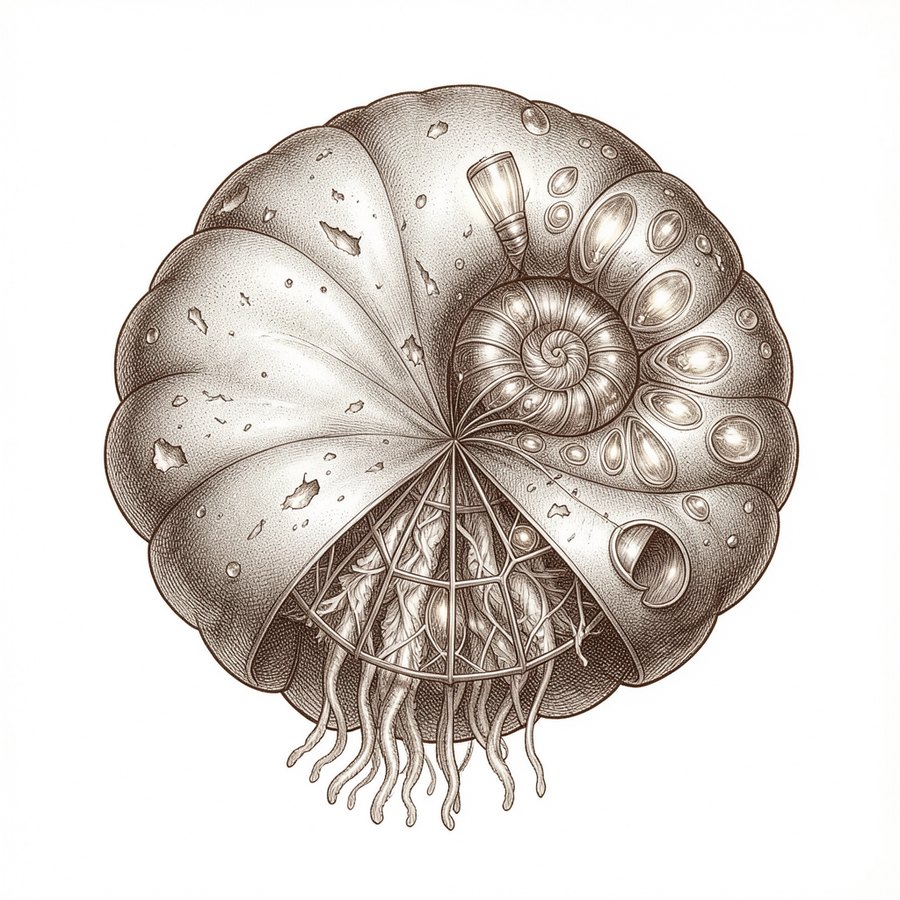
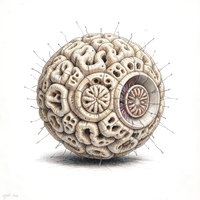
From Greek klinein, to slope, as in a cline, and phagein, to eat, and Latin evanescens, vanishing; it eats the slope it lives on and vanishes before the slope is gone.
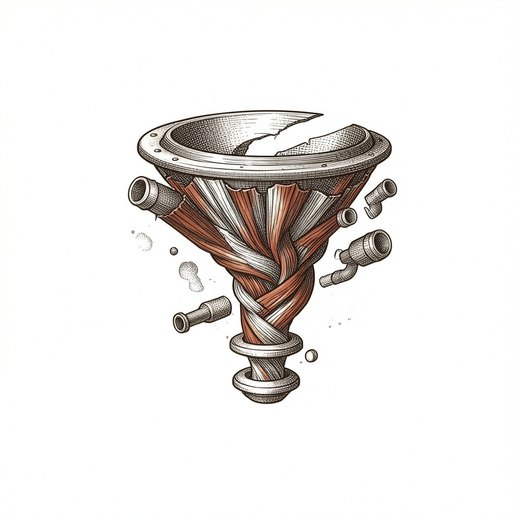
Plate XLVIII. Clinophagus evanescens, the whole specimen.
Order appears where a difference is steep because ordered flow levels it faster than chance, so every such pattern is entropy's shortcut and works toward its own end.
Order is the fastest way down.
behavior Gathers wherever warm meets cold and whirls there, faster the sharper the edge; as the edge softens it slows, and it is gone before the edge is.
provocation
What difference do you live on, and what will you be when your work has closed it?
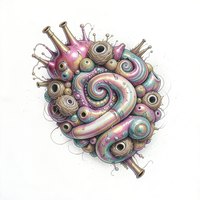
Each draw is the being derived afresh by the current laws at another seed (laws §11); the chosen one leads (where they sit in the morphospace).
I Dissection
Each organ answers one question about the idea. The framed one, its mechanism, is
the dominant organ: the being's class, the one the idea could not lose and stay itself.
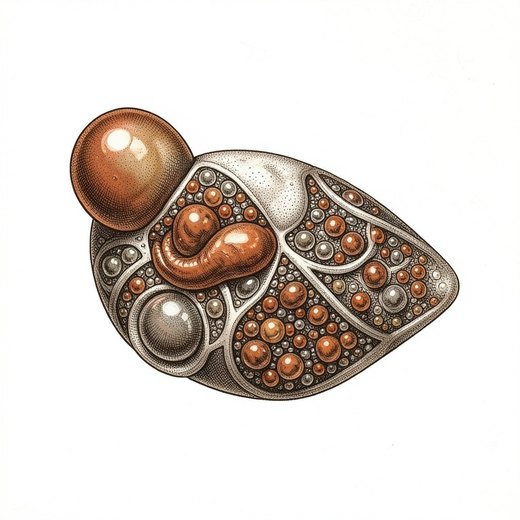
Fig. 1. Kernel
Dissipative structure
Which premise, if it were false, would kill this idea?
Ordered patterns arise where a difference is steep because an ordered flow levels the difference faster than random exchange can; order is how a gradient spends itself quickly.5, 4
drawn as: condensation nucleus · view: magnified
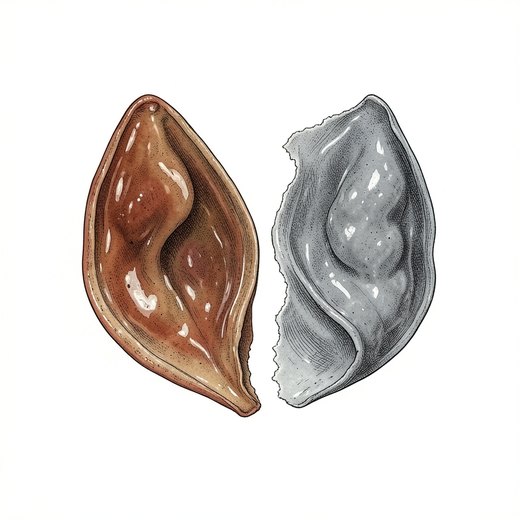
Fig. 2. Boundary
Far from equilibrium
What sets it apart from what it is not, and how does it keep that distinction?
It is set apart from equilibrium by needing a difference kept up from outside, and from a machine by having no designer; it lives only between a source and a sink.3
What must it feed on to work? What has to be present, noticed or supplied?
It feeds on any gradient, a difference of temperature, pressure, concentration or price, and is fed faster the steeper the difference; time alone does not feed it.1, 5
How does it turn what it takes in into what it gives out?
Simple local rules repeated among many parts add up to one shared current, a convection cell, a vortex or a trade, that carries the difference down faster than the parts could one by one.2, 4
drawn as: convection cell · view: exploded
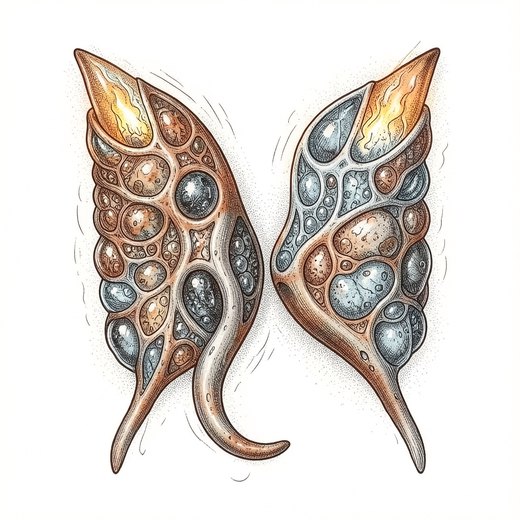
Fig. 5. Output
Honeycomb cells
What does it make possible, visible or knowable?
It gives the cells, storms, whirlpools, forests and markets that appear wherever a difference is large, and it brings the even state sooner than it would come alone.5, 7
drawn as: precipitation · view: at work
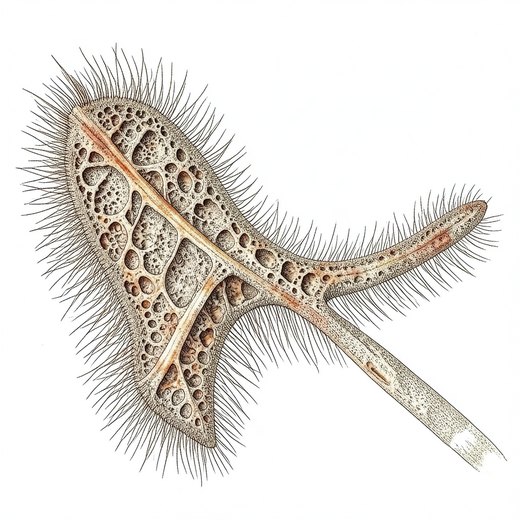
Fig. 6. Dispersal
Bathtub vortex
What part of it travels into other minds, ideas and fields, and by what vector?
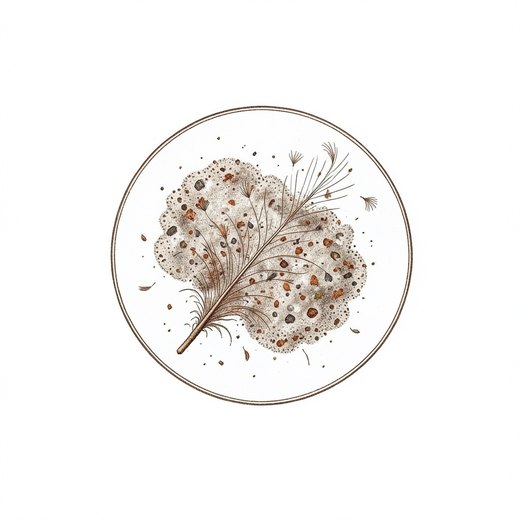
It travels as the whirlpool in a draining bath, as the saying that nature abhors a gradient, and as the trader's rule that every margin is competed away.6, 8
drawn as: plume · view: microscope
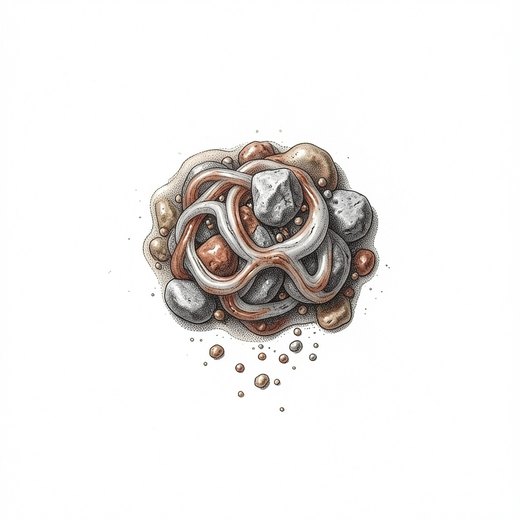
Fig. 7. Decay
Slack water
What can it not digest, where does it fail, and what does it leave behind for others?
Its success is its end; as the slope flattens the flow weakens, until below a threshold the pattern collapses and leaves a last small difference to slow diffusion, so it never finishes its own work.4, 8
drawn as: dissipation · view: detached
II Meaning associations
descent membership food web resemblance or friction
Bred by grafting, transfer of method, in the market habitat, which selects exchangeability, desire, price.
What it changes in its parents
Emergence: The new levels of Emergence are not free gifts of complexity; they appear because they spend a difference faster, so every emergent whole is also a faster way down.
Entropy: Entropy is not only decline. Its own increase builds the local orders it seemed unable to explain, since order is the shortcut it takes.
a learning machine that stops once its error has no slope left
If it is right
An order that lives on a difference closes that difference faster than it would close without it, and lasts about as long as the closing takes; its lifetime can be estimated from how steep the difference is and how fast it is being levelled.
Every such order stops before the difference is gone and leaves a remnant too shallow to drive it, as convection stops below a threshold and a market keeps margins too thin for any trader.
Orders that last do so by finding new differences or by having one kept up from outside; a living thing is fed by the sun, and an organization whose cause is won looks for another, as the March of Dimes turned to birth defects after the polio vaccine.
Fruits
tool
The gradient ledger
A one-page sheet for any project, firm, movement or job. Write down the difference it lives on (a margin, a gap in knowledge, an injustice, a temperature), how steep it is, how fast the work is closing it, and what will happen at the threshold where it can no longer drive the work; renew it, move to another, or end.
What difference do you live on, and what will you be when your work has closed it?
institution
The sunset charter
An organization founded with the difference it exists to close written into its charter, and a threshold at which it dissolves and gives back its means, instead of renewing itself with a new cause. It answers Entropy's provocation, something made to be used up whose value lies in how it disperses. Sunset clauses in law are its nearest kin.
Can an institution be built to end when it has succeeded?
game
Down the slope
A board game in which players earn by moving goods across differences on the board (heights, prices, temperatures), and each move flattens the difference it used. The game ends when no slope is left; the score rewards whoever moved to new slopes in time, or left the board first with the most.
When does an order that is winning lose its reason to exist?
artwork
The clock of order
A shallow pan of oil heated from below, then left to cool in a gallery. Hexagonal convection cells appear, thin out and vanish below the threshold, leaving still oil a little warmer at the bottom than at the top. It is a clock that shows how much time an order has left.4
How long does a pattern last once its difference begins to close?
bridge Both are statistics of many parts; what the many do together decides what is seen, and neither looks to any single part.
friction Entropy assumes order only decreases unless it is paid for elsewhere; Emergence assumes order can rise from the parts' own interaction. Each treats the other's arrow as a local exception.
tension If order is always paid for, what does order buy?
questions neither parent could ask
Is a pattern a way for a difference to spend itself faster?
Does every emergent whole carry the date of its own end, the day its gradient runs flat?
Could a whole be measured by how much disorder it makes, rather than by what it can do?
pollination: What does Entropy's premise become when it travels as the murmuration?
Sterile. Their vectors carry opposite images, so neither can carry the other's premise.
grafting: What does a mechanism that builds wholes from local rules do when it is fed nothing but gradients?
candidate
emergence
depth
ground
distance
total
heat-spender
2
2
3
1
8
Emanuel's hurricane as a heat engine is well grounded, but it lands next to the Storm founder already in the codex.
cool-canopy
3
2
3
2
10
Schneider and Kay's thermal surveys of forests ground it; it changes how one sees a forest, though not much else.
slope-eater
3
3
3
3
12
It applies to any order living on a difference, a business on a margin, a teacher on a gap in knowledge, a whirlpool on a drain. Bénard cells, Schneider and Kay, and the Grossman-Stiglitz paradox ground it. It is neither decline nor murmuration but order as entropy's shortcut, ending itself.
flat-learner
2
2
2
2
8
The gradient of machine learning is a slope of error, not a thermodynamic difference, so the kinship is partly a pun.
Record 2026-10-21-emergence-x-entropy in lab/.
How it was drawn
its draw 2, a point in the morphospace (laws §8), drawn by flux-2-klein-4b.safetensors.
axis
value
from
book
meteora
Entropy
symmetry
radial many
mutation
organization
segmented
Emergence
silhouette
cage
Emergence
scale
hand
Entropy
proportion
swollen
Entropy
growth
accretion
Entropy
articulation
tethered latent
Entropy
openness
hollow latent
Entropy
skeleton
woody latent
Emergence
locomotion
jetting
mutation
pattern
speckled latent
Entropy
coloration
nuptial latent
Emergence
substance
silica glass
mutation
surface
ribbed
Entropy
palette
sepia
Emergence
luminosity
sheen
Entropy
transparency
translucent latent
Entropy
gesture
coils
Entropy
unity
integral latent
Emergence
modality
contingent
Entropy
causation
efficient latent
mutation
determinacy
unmarked latent
Entropy
fusion
becoming
Emergence
anomaly
orbiting
Emergence
graft
lenses
Entropy
technique
engraving
mutation
viewpoint
above
Emergence
value
unmarked latent
Emergence
balance
grounded latent
mutation
density
intricate latent
Entropy
rhythm
regular latent
mutation
saturation
unmarked latent
Entropy
appendages
lanterns, petals
mutation
anchor (body)
a jellyfish bell with frilled oral arms trailing beneath
mutation
anchor (detail)
a nautilus shell cut open to show its spiral chambers
mutation
Sources
Rudolf Clausius, on the mechanical theory of heat (1865), where the word entropy is coined
John Holland, Emergence: From Chaos to Order (1998)
Ilya Prigogine and Isabelle Stengers, Order out of Chaos (1984)
Henri Bénard, Les tourbillons cellulaires dans une nappe liquide (Revue générale des sciences, 1900)
Eric Schneider and James Kay, Life as a manifestation of the second law of thermodynamics (Mathematical and Computer Modelling, 1994)
Eric Schneider and Dorion Sagan, Into the Cool: Energy Flow, Thermodynamics, and Life (2005)
Kerry Emanuel, An air-sea interaction theory for tropical cyclones (Journal of the Atmospheric Sciences, 1986)
Sanford Grossman and Joseph Stiglitz, On the impossibility of informationally efficient markets (American Economic Review, 1980)