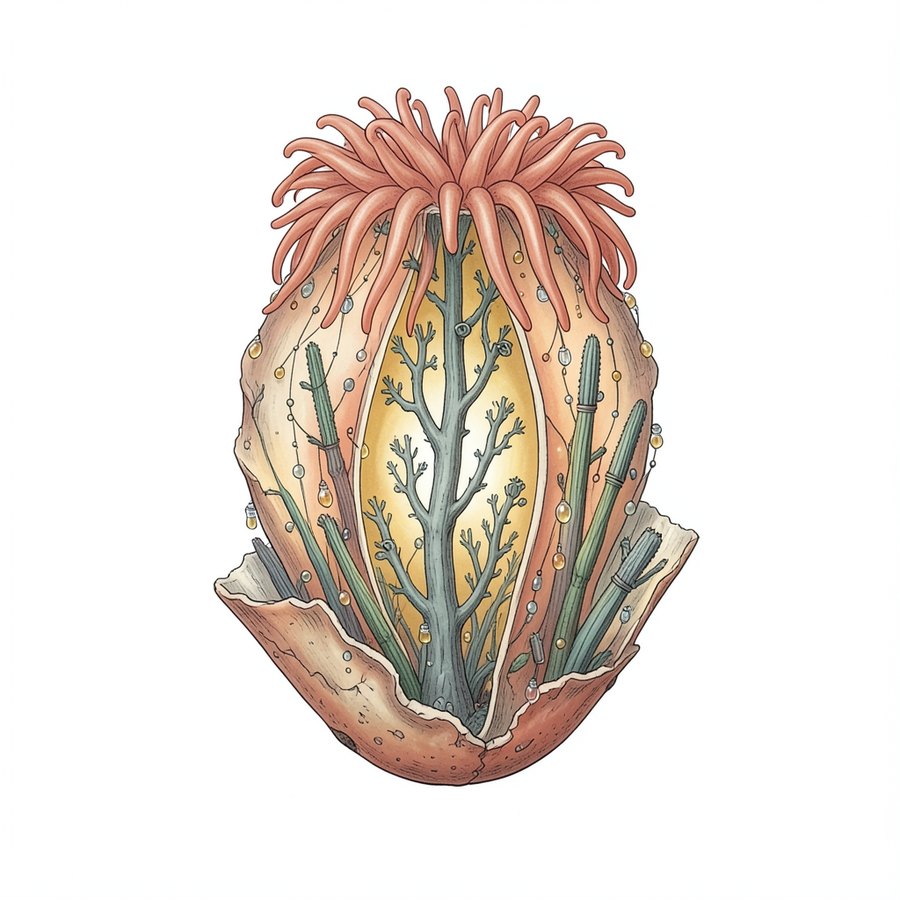
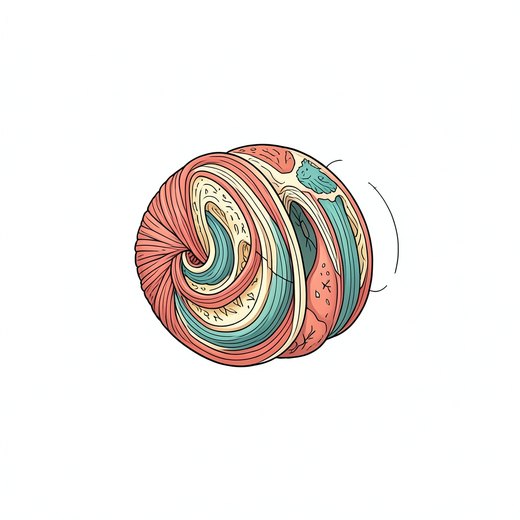
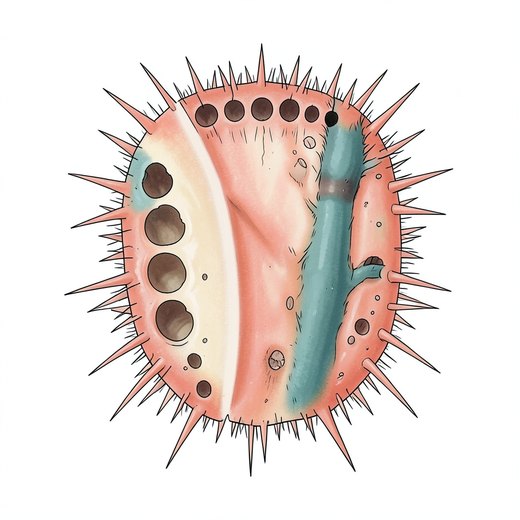
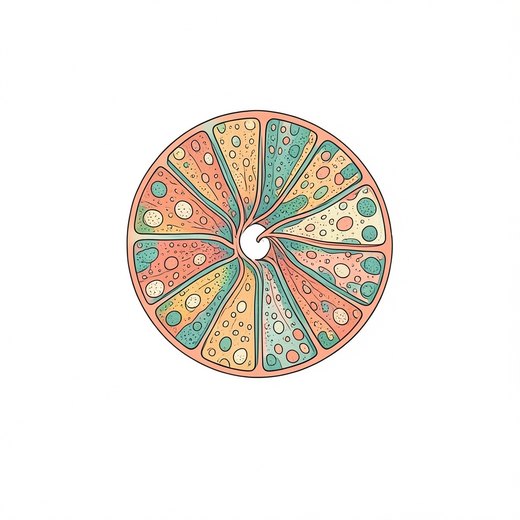
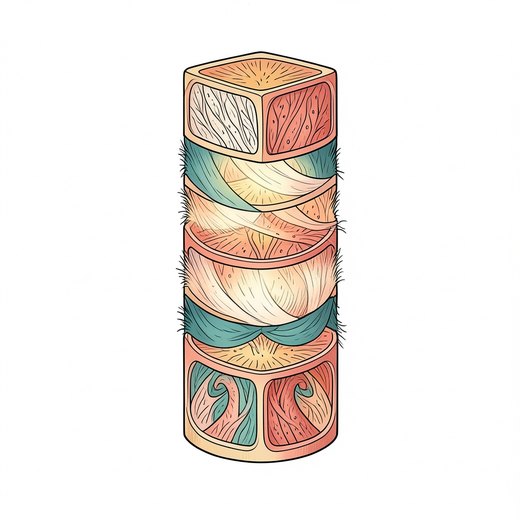
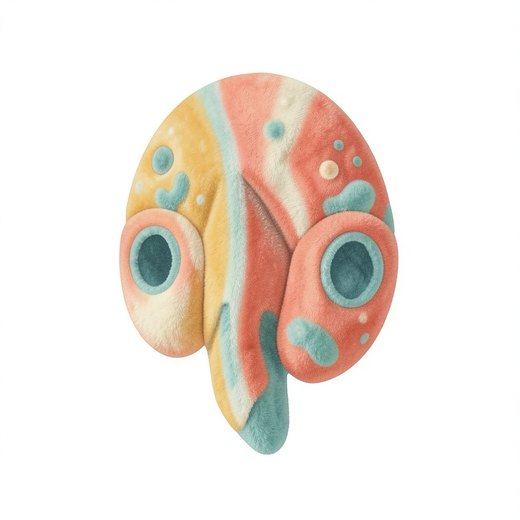
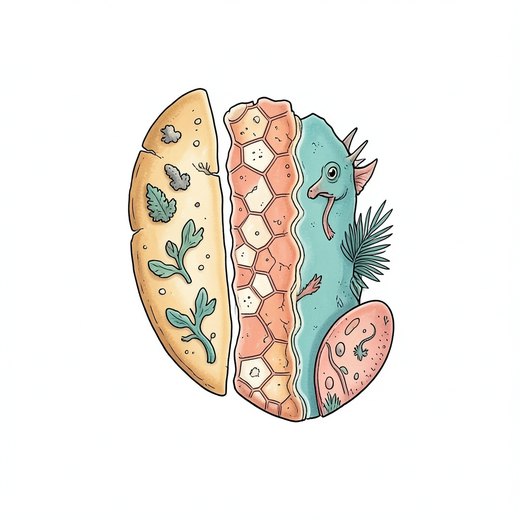
Plate LX. Aphaeresis sensoria, the whole specimen.
A science of what experience contains beneath what it is busy with, found by taking away one sense at a time, sound, light, movement, a quick breath, until the background that was always there can be inventoried.
What experience holds is found by taking away.
behavior Peels away its own outer layers one by one, and at each layer something faint that was underneath begins to glow.
provocation
What has been in your experience all your life that you have never noticed, because something louder was always there?
Each draw is the being derived afresh by the current laws at another seed (laws §11); the chosen one leads (where they sit in the morphospace).
I Dissection
Each organ answers one question about the idea. The framed one, its mechanism, is
the dominant organ: the being's class, the one the idea could not lose and stay itself.
Fig. 1. Kernel
Negative way
Which premise, if it were false, would kill this idea?
Experience holds a background, always there and never noticed because louder things fill it, and it can be found by taking away, one sense at a time, until it is all that is left.1, 2
drawn as: spark · view: exploded
Fig. 2. Boundary
Logbook
What sets it apart from what it is not, and how does it keep that distinction?
It is set apart from sensory deprivation research by its object, the background revealed rather than the subject's response, and from contemplative practice by keeping an inventory and comparing it across observers.2
drawn as: skin · view: pinned
Fig. 3. Intake
Anechoic chamber
What must it feed on to work? What has to be present, noticed or supplied?
It feeds on rooms built to take things away, anechoic chambers, dark rooms, flotation tanks, and on observers trained to report what remains.3, 2
drawn as: nerve net · view: transparent
Fig. 4. Mechanism
Unmasking
❦ dominant organ
How does it turn what it takes in into what it gives out?
Inputs are removed in a fixed order, sound, light, movement, a quick breath, and at each step observers report what was there all along and now appears, the hiss of blood, the eye's own light, the pulse in the fingertips.1, 3
drawn as: flush · view: cross section
Fig. 5. Output
Dark light
What does it make possible, visible or knowable?
It gives an inventory of the background of experience, the felt qualities that are always present and always masked, and the order in which they appear as the masks come off.1
drawn as: signal · view: at work
Fig. 6. Dispersal
Field guide
What part of it travels into other minds, ideas and fields, and by what vector?
It would travel through anechoic chambers opened to the public, float centres and quiet rooms, as maps of what one meets there.3
drawn as: contagion · view: microscope
Fig. 7. Decay
Prisoner's cinema
What can it not digest, where does it fail, and what does it leave behind for others?
It cannot take everything away, since the observer remains and each report adds something back, and what it finds may be made by the emptiness rather than revealed by it, as the shapes seen after days blindfolded are.4
drawn as: afterglow · view: cross section
Fig. 8. Substrate
Noise floor
What territory of phenomena does it live on?
Its ground is the background of experience, the felt qualities beneath whatever attention is busy with.1
drawn as: substrate · view: microscope
Fig. 9. Climate
Sensory panel
What counts as evidence and as a good result here?
A quality counts as found when observers who take away the same inputs in the same order report it in the same terms, and when, once named, it can still be found in ordinary conditions by turning attention to it.2
Qualia is what it inventories, Silence its first subtraction, and Breath the last input it slows.
Fig. 11. Ecotones
Ganzfeld
Where does it border other fields, and what grows at those borders?
It borders sensory deprivation research, which studies the response to taking away; phenomenology, which describes experience without taking anything away; and hesychology, which measures stillness by its depth; at its margins grow float centres and Cage's chamber.2
drawn as: ecotones · view: exploded
pioneer
Fig. 12. Succession
Blueprint
What stage is it in, pioneer, maturing, climax or disturbed?
It does not exist yet; this entry is its founding proposal.
II Meaning associations
descent membership food web resemblance or friction
Cage hearing two sounds in the anechoic chamber at Harvard
floaters drifting across a blank sky
one's own pulse heard in the pillow at night
the dark of a flotation tank
If it is right
Observers who take away inputs in the same order report the same background qualities appearing in the same order, the sounds of the body first, then the eye's own light, then the pulse.
Qualities found by subtraction stay noticeable once named, so trained observers report them more often in ordinary life afterwards.
Some reports, such as shapes seen in the dark, grow with time in the empty room rather than appearing at once, which marks them as made by the emptiness rather than revealed by it.
Fruits
study
The order of the background
Take observers through the same sequence of subtractions, sound, light, movement, breath, in rooms built for it, record what each reports at every step, and test whether the background qualities appear in the same order for all.2, 3
What was there before you noticed it?
artwork
An atlas of the unnoticed
An illustrated atlas of what appears when each sense is taken away, built from many observers' words, each quality drawn at the step where it appeared, from the first sounds of the body to the eye's own light in the dark.1
What would your atlas of the unnoticed hold?
practice
Taking away
Five minutes at night, lying in the dark, taking away one input at a time, sound with earplugs, light with a mask, movement by lying still, and noting the first thing that appears each time.
bridge All three are attended to from inside. Breath and silence are the oldest ways of turning attention onto experience itself.
friction Qualia is private and resists measurement; breath can be counted from outside; silence is only a condition, not an object.
tension Can a science take lived experience as evidence without trusting it blindly or explaining it away?
questions neither parent could ask
What would count as a good description of the moment a thought arises?
Can a trained report sort brain recordings better than the recordings sort themselves?
Why have contemplative traditions everywhere used the breath and silence to look at the mind?
succession: What field grows on lived experience, with breath and silence as its instruments?
Sterile. Every field imagined already exists under its own name; imagined again below.
candidate
emergence
depth
ground
distance
total
neurophenomenology
3
3
3
0
9
Named by Varela in 1996 and practised since; a recognition, not a founding. Already a field: neurophenomenology.
monastic-science
2
3
2
0
7
Old and real, and already named. Already a field: contemplative science.
micro-phenomenology
2
2
3
0
7
Petitmengin's interview method, already named. Already a field: micro-phenomenology.
quiet-lab
1
1
2
0
4
An apparatus inside an existing field. Already a field: experimental psychology.
succession: What field, not yet founded, would grow on what experience becomes as sound and breath are withdrawn?
candidate
emergence
depth
ground
distance
total
hesychology
3
3
2
3
11
Needs all three keystones: Silence and Breath as the two dials of stillness, Qualia as what changes. Grounded in the hesychast practice of stillness and breath prayer, in research on restricted stimulation and in work on perception across the breathing cycle, but no field takes stillness itself as its variable.
breath-cartography
2
2
3
1
8
Silence is not needed, and it is close to current research on perception across the breathing cycle.
inner-climatology
2
2
1
2
7
Little evidence that breath records say much about a life's inner climate.
silent-design
1
2
3
0
6
Already a field of its own. Already a field: architectural acoustics.
succession: What field, beyond the measuring of stillness, could Qualia, Breath and Silence found?
candidate
emergence
depth
ground
distance
total
perimetry-of-the-self
2
2
2
2
8
Close to research on body ownership. The author's stars, 2.
subtractive-phenomenology
3
3
2
3
11
A method, subtraction, and an object, the masked background, that neither sensory deprivation research nor phenomenology takes. The author's stars, 4.
synhesychy
2
2
2
2
8
A silent counterpart to collective effervescence. The author's stars, 3.
Record 2026-10-25-qualia-x-breath-x-silence in lab/.
How it was drawn
its draw 1, a point in the morphospace (laws §8), drawn by flux-2-klein-4b.safetensors.
axis
value
from
book
pathemata
Qualia
symmetry
spiral
Silence
organization
field
level
silhouette
bell
Silence
scale
hand
Silence
proportion
tapering latent
Qualia
growth
accretion
Silence
articulation
seamless latent
Breath
openness
lattice latent
Silence
skeleton
unmarked latent
Breath
locomotion
unmarked latent
level
pattern
stripes latent
mutation
coloration
nuptial latent
Qualia
substance
amber
mutation
surface
frosted
Silence
palette
coral
Qualia
luminosity
inner glow
Qualia
transparency
opaque latent
Breath
gesture
gathers
mutation
unity
aggregate latent
Silence
modality
contingent latent
Silence
causation
material latent
Silence
determinacy
dissolving latent
Breath
fusion
nested
mutation
anomaly
none
Silence
graft
vials
mutation
technique
chromolith
Silence
viewpoint
cutaway
Breath
value
flat
Breath
balance
unmarked latent
mutation
density
intricate latent
Qualia
rhythm
regular
Silence
saturation
muted
mutation
appendages
beaded filaments
Breath
anchor (body)
a sea anemone, a column crowned with rings of tentacles
Qualia
anchor (detail)
a fruticose lichen, branching grey-green stalks tipped with small cups
Breath
Sources
John Cage, Silence: Lectures and Writings (1961)
Peter Suedfeld, Restricted Environmental Stimulation: Research and Clinical Applications (1980)
John C. Lilly, The Deep Self: Profound Relaxation and the Tank Isolation Technique (1977)
Lotfi B. Merabet and others, Visual hallucinations during prolonged blindfolding in sighted subjects (Journal of Neuro-Ophthalmology, 2004)