Trust given knowingly to something empty can still change the one who gives it, because what acts is the act of trusting, not its object.
You can trust what you know to be empty, and it still holds you.
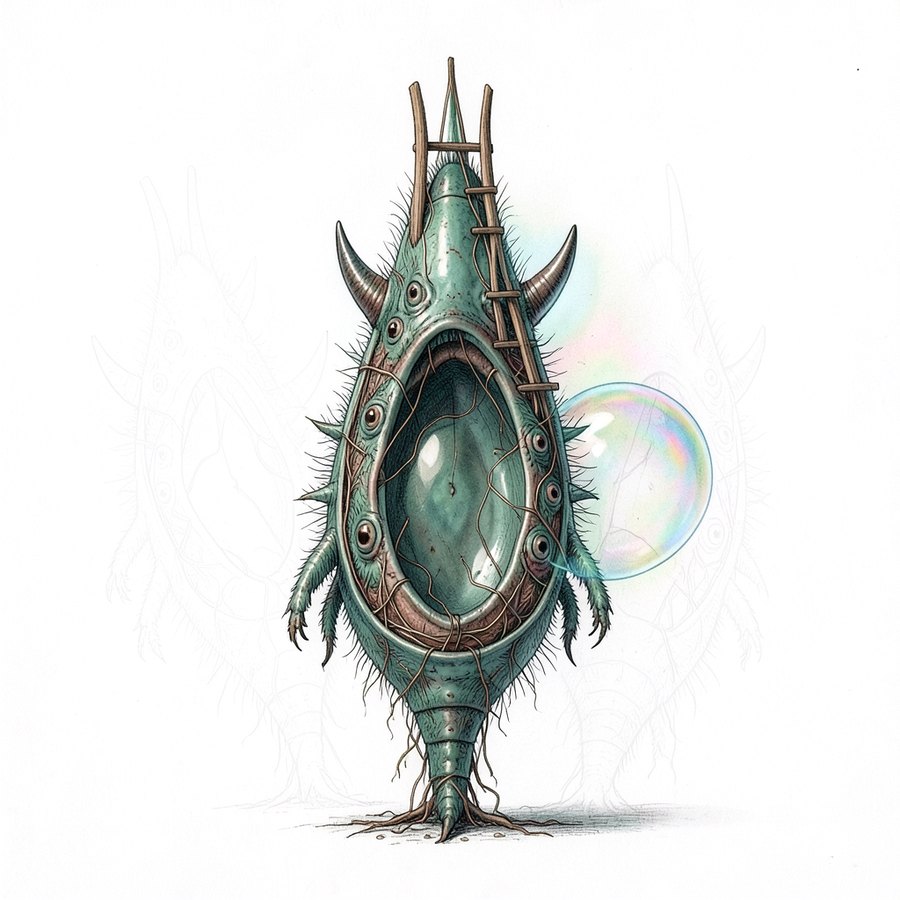
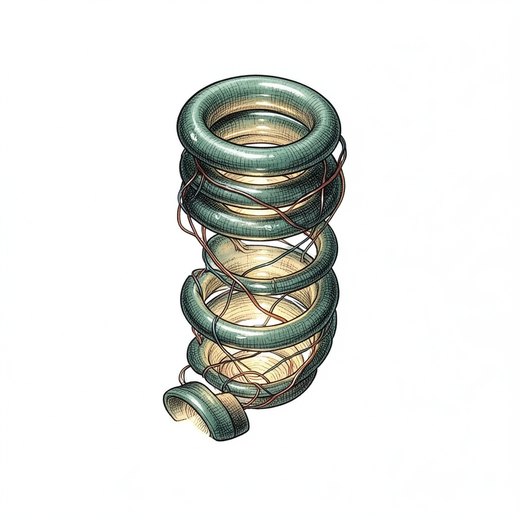
behavior Holds out an empty shell with great care, and glows only while it is being held.
provocation
What would you keep doing if you were told it was only a gesture?
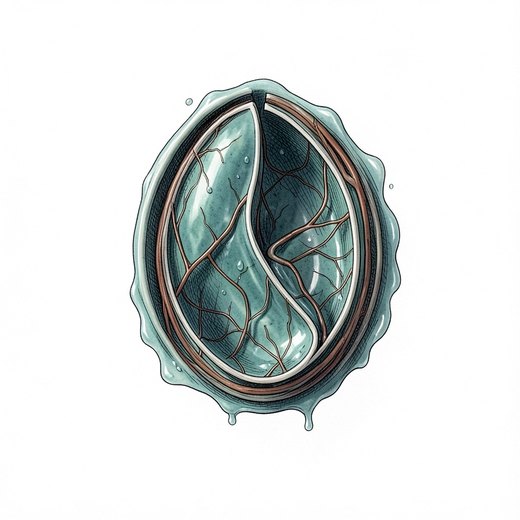
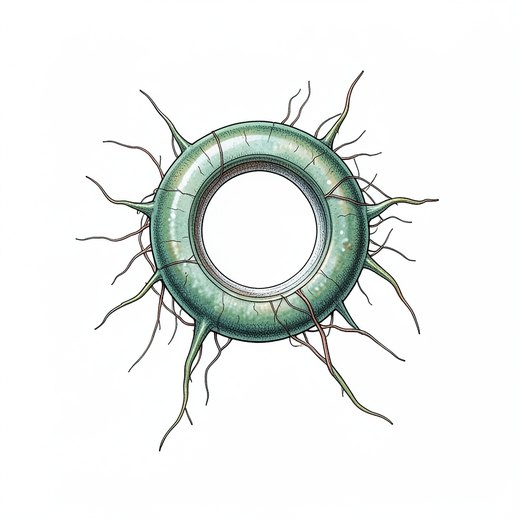
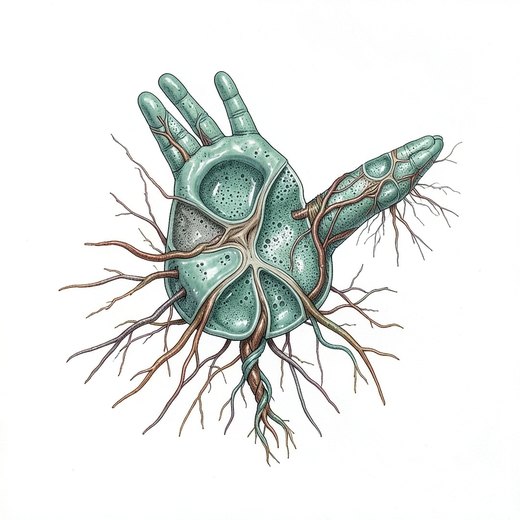
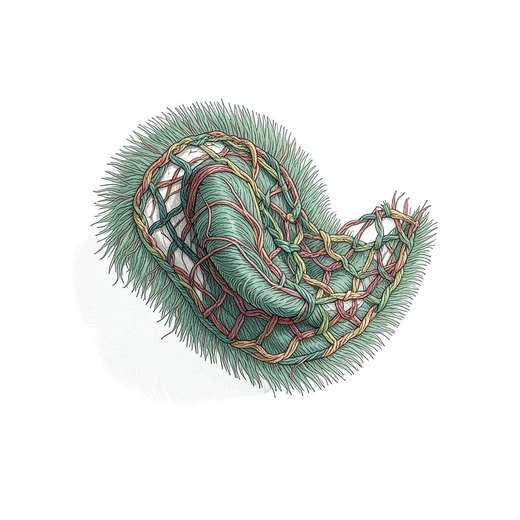
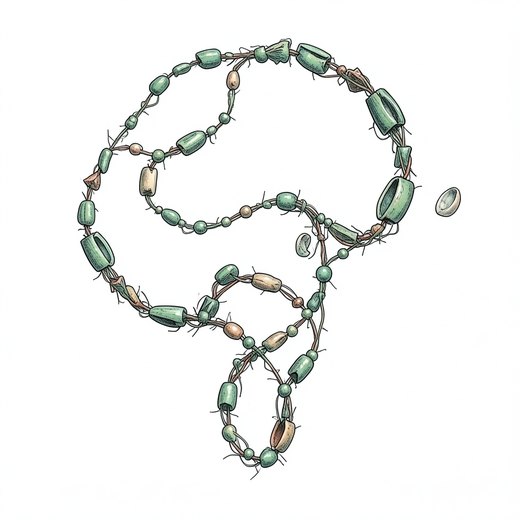
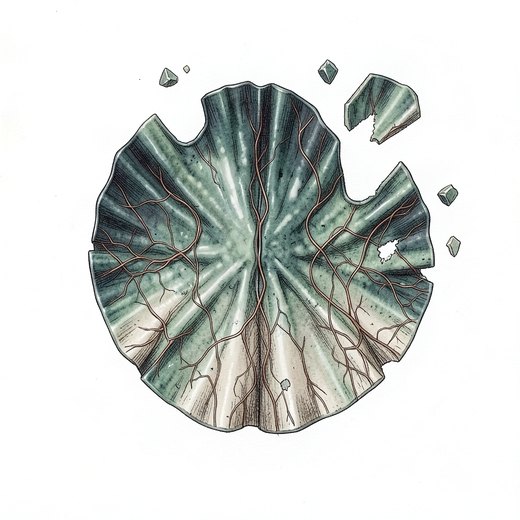
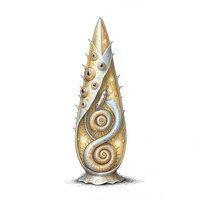
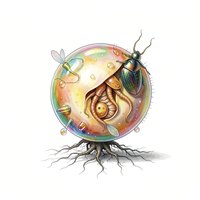
Each draw is the being derived afresh by the current laws at another seed (laws §11); the chosen one leads (where they sit in the morphospace).
I Dissection
Each organ answers one question about the idea. The framed one, its kernel, is
the dominant organ: the being's class, the one the idea could not lose and stay itself.
Which premise, if it were false, would kill this idea?
Trust given to something one knows to be empty still acts, because what changes the one who trusts is the act of trusting, not what it is given to.3, 2
What must it feed on to work? What has to be present, noticed or supplied?
It feeds on a gesture of trust made openly, a pill taken as a pill, a charm carried as a charm, a rite kept by someone who no longer believes its story.2
What part of it travels into other minds, ideas and fields, and by what vector?
It travels as open-label trials, as a doctor saying plainly that this is a sugar pill and it may help, and as the habits of people who keep rites they no longer believe.3, 1
What can it not digest, where does it fail, and what does it leave behind for others?
It cannot be summoned by knowing alone; without the gesture and the care around it it does nothing, and some of its supposed effects, such as the lucky charm's, have failed to replicate.5, 6
drawn as: corrosion · view: detached
II Meaning associations
descent membership food web resemblance or friction
a funeral rite kept by someone who no longer believes
a lucky charm carried with a smile
a deep breath taken because someone said it would help
If it is right
Open-label placebos keep a measurable effect where expectation matters, such as chronic pain and irritable bowel syndrome, even when patients are told the pills are inert.
The effect grows with the care and ritual around the gesture, the time taken and the explanation given, not with any belief that the pill is active.
Charms and superstitions held knowingly help little or not at all unless they come with a gesture of care, which is why the lucky-charm finding did not replicate.
Fruits
practice
The honest prescription
A short script for offering an open-label placebo in general practice, saying what the pill is, why it may help, and asking the patient to take it with the same care as any medicine, tried first for chronic pain and irritable bowel, where the trials are.3, 4
What can you give someone that works because you told them the truth about it?
study
Care without a story
Give open-label placebos to two groups with the same honest explanation, one with the full ritual of care, time taken, a careful hand-over, a follow-up call, and one with the pills simply posted, and compare their relief. If the ritual carries the effect, it is the act of trusting that acts, not belief in the pill.3, 4
What would you keep doing if you were told it was only a gesture?
artwork
The empty reliquary
An exhibition of reliquaries made to be openly empty, each labelled as such, which visitors may take in their hands for a while, then leave a word about what holding it did. It asks whether care given to an empty vessel still changes the one who gives it.
bridge Both are predictions that help make what they predict; what is expected arrives partly because it is expected.
friction Faith assumes its object is real, though unseen, and is wounded by disproof. Placebo's object is known to be empty by the one who gives it, and in open-label use by both.
tension Can trust in something known to be empty still act, and if it can, what is being trusted?
questions neither parent could ask
If testimony carries faith from one believer to the next, can it carry relief from one patient to the next?
What is a faith that knows its object is empty, and works anyway?
A trial gives one group a sugar pill to measure belief; what would be the control arm for a community's shared trust?
pollination: What happens to a remedy made only of meaning when it travels the way faith travels, by witness, from one person to the next?
candidate
emergence
depth
ground
distance
total
votive-wall
2
2
3
1
8
A shrine already joins faith and healing; Placebo adds little that Lourdes does not have. This is faith healing again.
witness-balm
3
3
3
2
11
It needs Placebo's premise that meaning alone acts and Faith's vector that meaning passes by witness. Observational placebo analgesia, placebo by proxy and mass sociogenic illness are all measured. It is close to the known idea of social contagion, hence 2 on distance.
testimonial
1
1
3
1
6
Mostly Placebo's own intake, the look and price of the remedy.
feed-of-recoveries
2
2
1
2
7
Nothing shows that a screen passes relief the way a person in the same room does.
crossing: What is a trust given to something one knows to be empty, and why does it still act?
candidate
emergence
depth
ground
distance
total
knowing-trust
3
3
3
2
11
It needs Faith's premise that acting on a trust makes it real and Placebo's finding that the effect survives disclosure. Open-label placebo trials in irritable bowel syndrome and back pain ground it. It is near the open-label placebo itself, hence 2 on distance, but it reaches past medicine to rites and charms.
as-if-rite
2
3
2
2
9
Vaihinger's philosophy of as if already holds it; Placebo adds little to Ritual here.
honest-charm
2
1
1
2
6
The study that found lucky charms improved performance did not replicate.
self-prescribed-sugar
1
1
2
1
5
Placebo alone, sold.
Record 2026-10-21-placebo-x-faith in lab/.
How it was drawn
its draw 1, a point in the morphospace (laws §8), drawn by flux-2-klein-4b.safetensors.
axis
value
from
book
automata
Faith
symmetry
amorphous
mutation
organization
nested
Faith
silhouette
spire
Faith
scale
hand
Faith
proportion
graded latent
Faith
growth
grafted
mutation
articulation
seamless latent
Faith
openness
hollow
Faith
skeleton
woody latent
Faith
locomotion
sessile
Faith
pattern
spots latent
Faith
coloration
countershaded latent
mutation
substance
porcelain
Faith
surface
filamentous
Faith
palette
verdigris
mutation
luminosity
sheen
mutation
transparency
clouded latent
Faith
gesture
sinks
mutation
unity
integral latent
Faith
modality
possible
mutation
causation
final latent
Faith
determinacy
dissolving latent
Faith
fusion
becoming
Faith
anomaly
scale clash
Faith
graft
scaffold
Faith
technique
hatching
Faith
viewpoint
below
Faith
value
unmarked latent
Faith
balance
leaning latent
mutation
density
unmarked latent
Faith
rhythm
regular latent
mutation
saturation
accent latent
Faith
appendages
horns, ocelli
Faith
anchor (body)
a tardigrade, a plump segmented body on stubby clawed legs
Faith
anchor (detail)
a soap bubble, a sphere of iridescent film
Placebo
Sources
William James, The Will to Believe (1896)
Hans Vaihinger, The Philosophy of 'As If' (1911)
Ted J. Kaptchuk and others, Placebos without Deception: A Randomized Controlled Trial in Irritable Bowel Syndrome (PLoS ONE, 2010)
Cláudia Carvalho and others, Open-label placebo treatment in chronic low back pain: a randomized controlled trial (Pain, 2016)
Lysann Damisch, Barbara Stoberock and Thomas Mussweiler, Keep Your Fingers Crossed! How Superstition Improves Performance (Psychological Science, 2010)
Robert J. Calin-Jageman and Tracy L. Caldwell, Replication of the Superstition and Performance Study by Damisch, Stoberock, and Mussweiler (2010) (Social Psychology, 2014)