a founder of the codex
Entanglement
Synlithus inseparabilis·the Inseparable Stone
From Greek syn, together, and lithos, stone, and Latin inseparabilis, that cannot be parted; stones that are one before they are two.
- Level
- Conceptorganism
- Book
- Nidithe architecture of animals
- Phylum
- Linkimage schema
- Class
- Kernelits first cell
- Niche
- Symbionta partner
- Mode
- Reproductionhow it keeps existing
- Stage
- Juvenileindividuating
- Status
- Living
- Habitat
- Laboratory
Its kinds · Roget, 1852: Relation · Wilkins, 1668: Transcendental Mixed · WordNet, 1990: Relation · Llull, 1308: I · Elementative
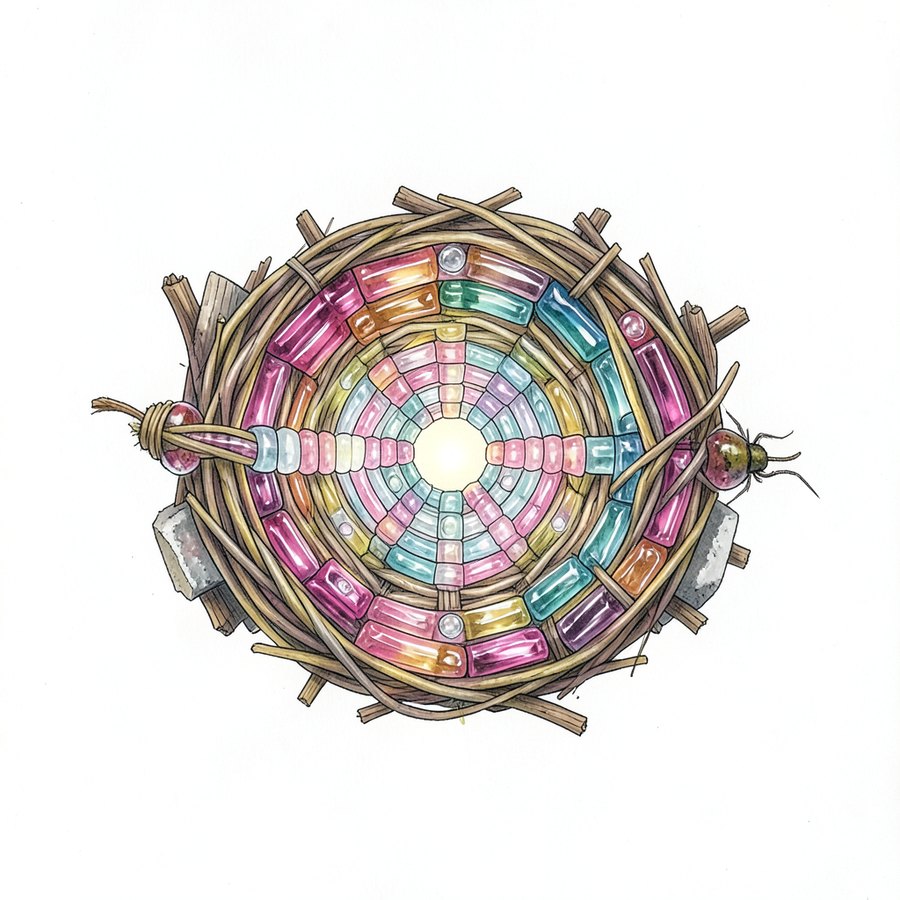
Some pairs share one state and have none of their own, so the pair is more real than either part.
Some wholes have no parts of their own.
behavior Always grows in pairs, and when one twin is turned the other is found turned the same way, however far apart they lie.
Which relationship in your life could not be described by describing each person separately?
I Dissection
Each organ answers one question about the idea. The framed one, its kernel, is the dominant organ: the being's class, the one the idea could not lose and stay itself.
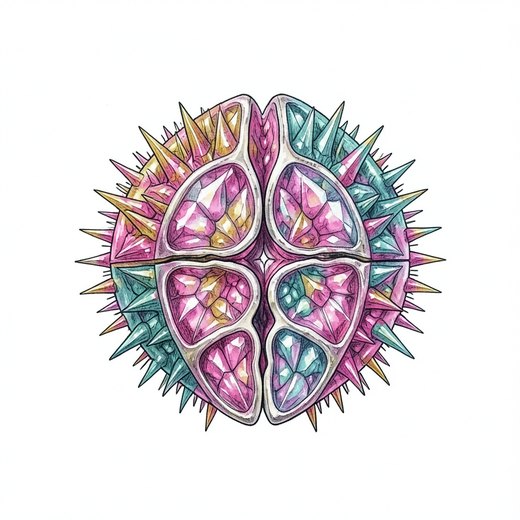
Fig. 1. Kernel
Singlet state
❦ dominant organWhich premise, if it were false, would kill this idea?
Two systems can share a single state, so that neither has a state of its own and only the pair can be described.2, 1
drawn as: first cell · view: transparent
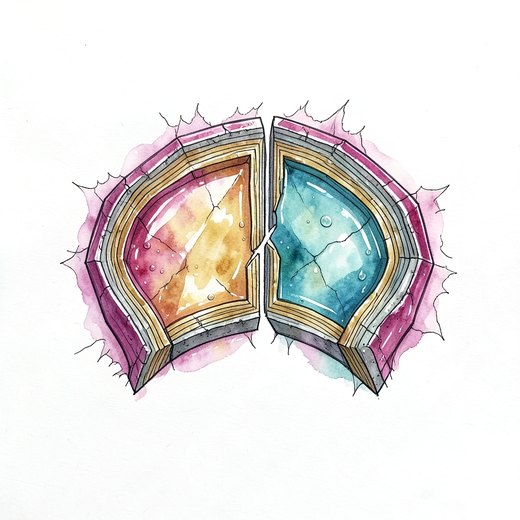
Fig. 2. Boundary
Local bound
What sets it apart from what it is not, and how does it keep that distinction?
It is set apart from ordinary correlation by Bell's limit; correlations a local account could explain are not entanglement.3
drawn as: wall · view: cross section
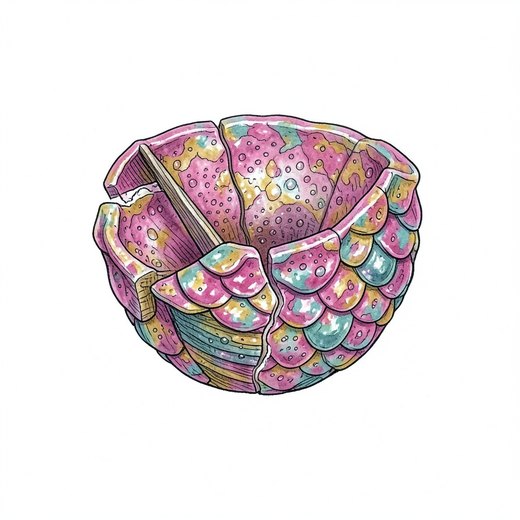
Fig. 3. Intake
Down-conversion
What must it feed on to work? What has to be present, noticed or supplied?
It needs systems that interacted or were made together, and isolation from everything else that would touch them.5
drawn as: gathered material · view: in situ
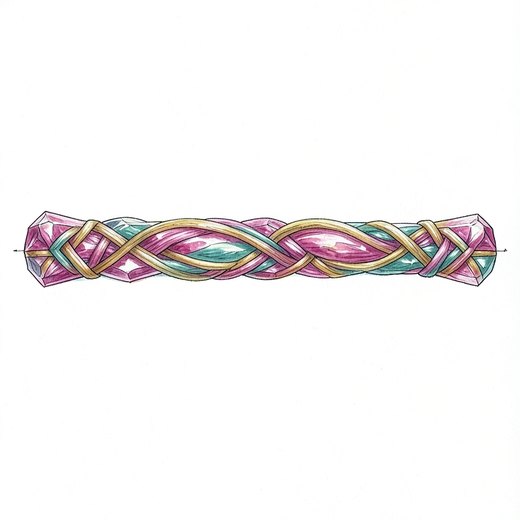
Fig. 4. Mechanism
Spooky action
How does it turn what it takes in into what it gives out?
Their joint state cannot be split into separate parts, so measuring one fixes what will be found in the other, though no signal passes between them.3, 4
drawn as: weave · view: magnified
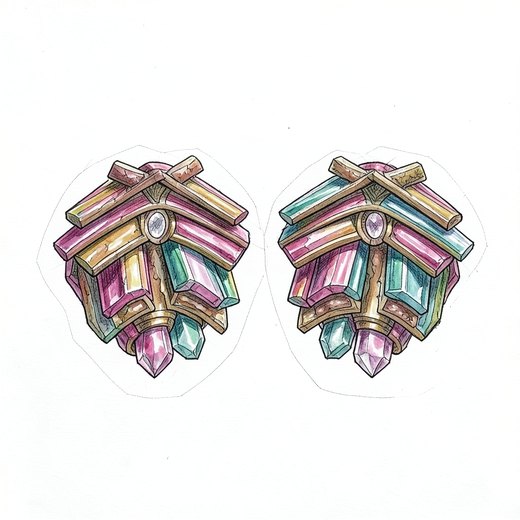
Fig. 5. Output
Quantum key
What does it make possible, visible or knowable?
It gives correlations stronger than any local account allows, and the means of quantum computing and secure communication.3, 4
drawn as: chamber · view: at work
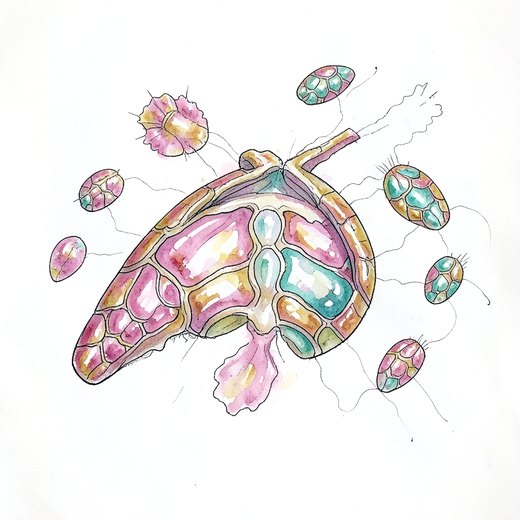
Fig. 6. Dispersal
Twin souls
What part of it travels into other minds, ideas and fields, and by what vector?
It travels as the image of two things bound across distance, used for lovers, twins and ecosystems, usually stretched beyond what it means.1
drawn as: copy · view: series
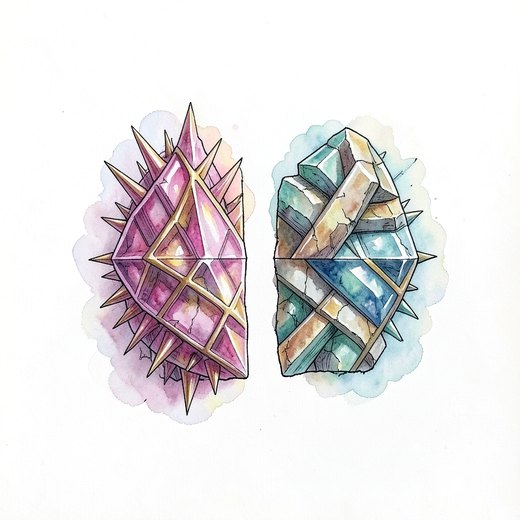
Fig. 7. Decay
Decoherence
What can it not digest, where does it fail, and what does it leave behind for others?
Any contact with the environment spreads the correlation into it until it is lost, which is why the everyday world looks classical.5
drawn as: ruin · view: detached
II Meaning associations
descent membership food web resemblance or friction
Lineage
A founder, dissected by hand.
Offspring
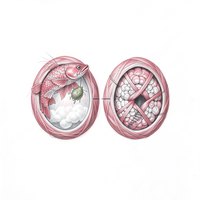
Food web
- friction its kernel rubs against the kernel of Solitude
Solitude is one mind apart; Entanglement is a pair with no state of its own. Each denies the other's unit. - homology its intake resembles the intake of Solitude
Both need isolation, Solitude from other people's attention, Entanglement from everything that would touch the pair.
Kin
same kind in Roget Mimesis
same kind in Wilkins Emergence, Entropy, Symmetry, Self-Ending Order
same kind in Llull Amber, Emergence, Entropy, Erosion, Fire, Rain, Resonance, Resonance (Automata), Salt, Storm, Wind, Self-Ending Order
same phylum Apophenia, Mimesis, Resonance (Automata), Symbol, Shared Breath, Witnessed Relief, Witnessed Relief (Mycelia)
same dominant organ Entelechy, Geomancy, Qualia, Salt, Syllable, Symmetry, Vertigo, Volition, Knowing Trust, Hesychology
Genome
- non-separability
- correlation
- measurement
- nonlocality
- decoherence
III In the world
Echoes
- Bell test experiments
- photon pairs born in a crystal, used in quantum cryptography
- quantum computers
- the EPR paradox
IV Record
How it was drawn
its draw 2, a point in the morphospace (laws §8), drawn by flux-2-klein-4b.safetensors.
| axis | value | |
|---|---|---|
| book | nidi | |
| symmetry | concentric | |
| organization | segmented | |
| silhouette | cage | |
| scale | hand | |
| proportion | sheared latent | |
| growth | intercalary | |
| articulation | sutured | |
| openness | spongy latent | |
| skeleton | test latent | |
| locomotion | unmarked latent | |
| pattern | plain latent | |
| coloration | nuptial | |
| substance | crystal | |
| surface | banded | |
| palette | bismuth | |
| luminosity | inner glow | |
| transparency | transparent | |
| gesture | joins | |
| unity | aggregate latent | |
| modality | necessary latent | |
| causation | material latent | |
| determinacy | unmarked latent | |
| fusion | becoming | |
| anomaly | knotted | |
| graft | vials | |
| technique | watercolour | |
| viewpoint | above | |
| value | unmarked latent | |
| balance | unmarked latent | |
| density | unmarked latent | |
| rhythm | alternating latent | |
| saturation | vivid latent | |
| appendages | cilia | |
| anchor (body) | a beaver lodge of sticks and mud rising from water | |
| anchor (detail) | a potter wasp's tiny clay pot with a flared neck |
Sources
- Einstein, Podolsky and Rosen, Can Quantum-Mechanical Description of Physical Reality Be Considered Complete? (1935)
- Erwin Schrödinger, Discussion of probability relations between separated systems (1935)
- John Bell, On the Einstein Podolsky Rosen Paradox (1964)
- Alain Aspect, Philippe Grangier and Gérard Roger, Bell test experiments (1982)
- Wojciech Zurek, Decoherence and the transition from quantum to classical (1991)
❦