a founder of the codex
Symmetry
Invariantia gemella·the Mirror Spar
From Latin invariare, to stay unchanged, and gemellus, a twin; a stone that stays the same under every turn and grows in twins.
- Level
- Conceptorganism
- Book
- Semaphorathe bestiary of display
- Phylum
- Balanceimage schema
- Class
- Kernelits glyph
- Niche
- Producerraw experience
- Mode
- Referencehow it keeps existing
- Stage
- Matureindividuated
- Status
- Living
- Habitat
- Archive
Its kinds · Roget, 1852: Form · Wilkins, 1668: Transcendental Mixed · WordNet, 1990: Attribute · Llull, 1308: F · Imaginative
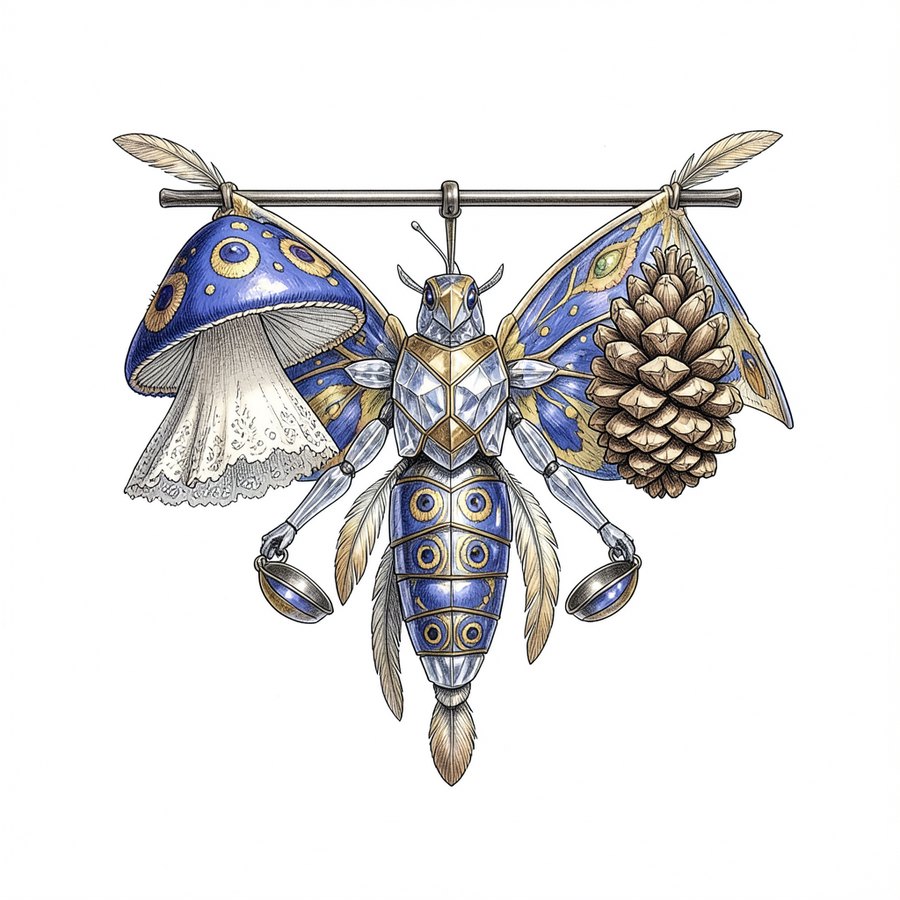
What stays the same when something is turned, mirrored or moved tells you what that thing really is.
What does not change under change is what is real.
behavior Grows only by repeating itself exactly, and cracks with a bright sound whenever something forces it to choose a side.
Which symmetry would have to break in a life, or a city, for something new to form there?
I Dissection
Each organ answers one question about the idea. The framed one, its kernel, is the dominant organ: the being's class, the one the idea could not lose and stay itself.
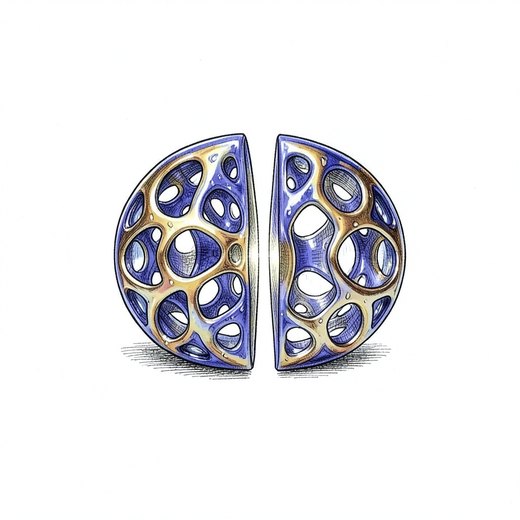
Fig. 1. Kernel
Mirror plane
❦ dominant organWhich premise, if it were false, would kill this idea?
A thing is symmetric when some change, a rotation, a reflection or a shift, leaves it as it was.1
drawn as: glyph · view: exploded
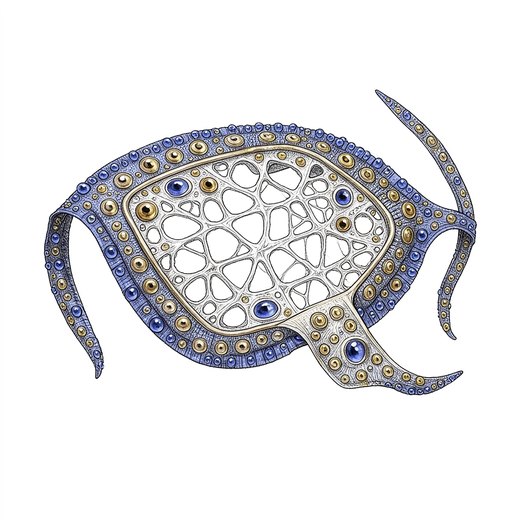
Fig. 2. Boundary
Scalene triangle
What sets it apart from what it is not, and how does it keep that distinction?
It is defined against the singular; whatever no transformation leaves unchanged lies outside it.1
drawn as: margin · view: cross section
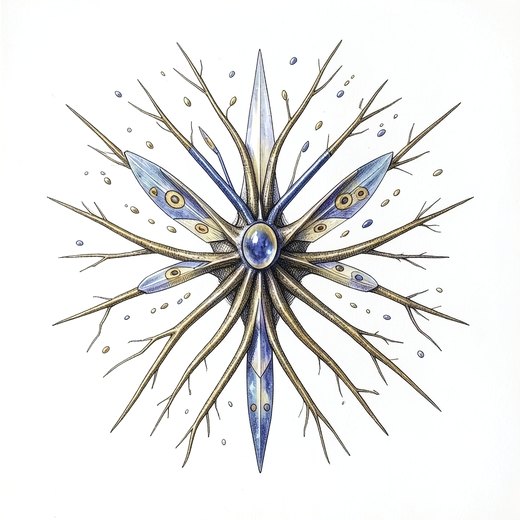
Fig. 3. Intake
Motif
What must it feed on to work? What has to be present, noticed or supplied?
It needs a form and a set of transformations to test against it, whether a pattern, an equation or a law.1
drawn as: ocellus · view: pinned
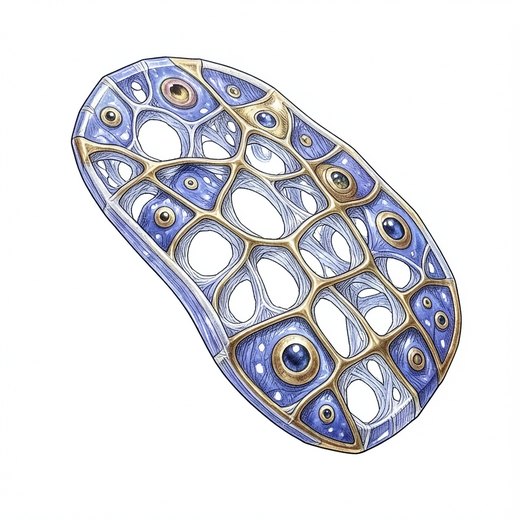
Fig. 4. Mechanism
Kaleidoscope
How does it turn what it takes in into what it gives out?
The transformations that leave a form unchanged combine with one another into a group, so knowing a few of them fixes all the rest.1
drawn as: chromatophore · view: cast
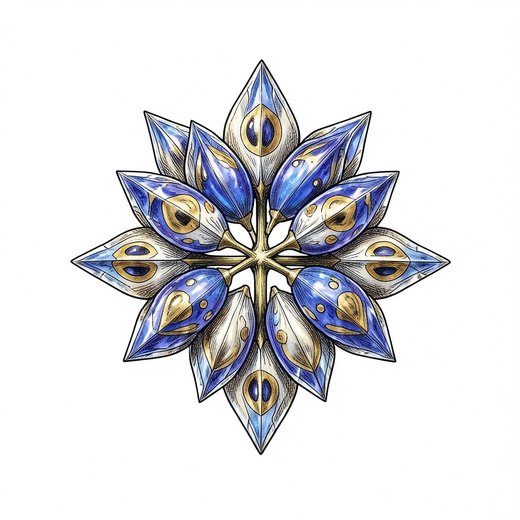
Fig. 5. Output
Wallpaper groups
What does it make possible, visible or knowable?
It yields classifications, such as the seventeen plane patterns and the 230 crystal groups, and in physics every continuous symmetry gives a conserved quantity.3, 2
drawn as: display · view: detached
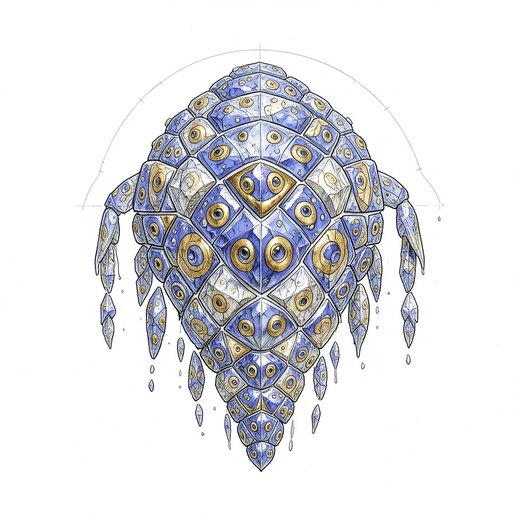
Fig. 6. Dispersal
Rose window
What part of it travels into other minds, ideas and fields, and by what vector?
It travels as a standard of beauty and balance in faces, buildings and ornament, and as a working tool of physics and chemistry.1
drawn as: ink · view: series
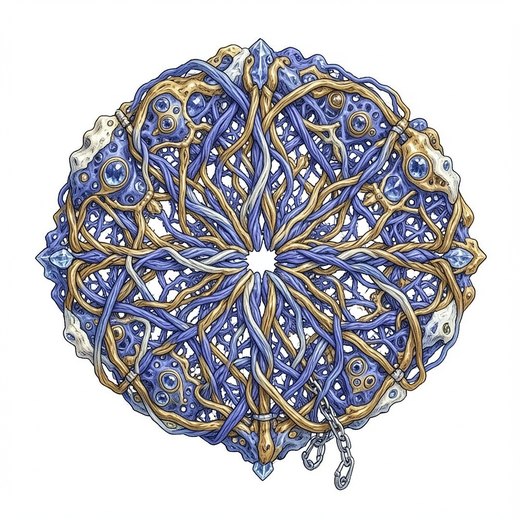
Fig. 7. Decay
Mexican hat
What can it not digest, where does it fail, and what does it leave behind for others?
It cannot hold what is singular or in motion; when it breaks, new structure appears, as in a magnet or a growing snowflake, and as an aesthetic it hardens into dead regularity.1
drawn as: palimpsest · view: magnified
II Meaning associations
descent membership food web resemblance or friction
Lineage
A founder, dissected by hand.
Food web
- friction its kernel rubs against the kernel of Fear
Symmetry is what stays the same under a change; Fear is a change that sweeps everything before it. One is an invariant, the other a disturbance. - friction its decay rubs against the output of Fear
Symmetry breaks in motion; Fear gives motion, the startle and the flight. What Fear makes, Symmetry cannot hold. - homology its dispersal resembles the dispersal of Fear
Both travel through faces, Symmetry as a standard of beauty and Fear as an expression caught from one face by the next. The meeting is on the face.
Kin
same kind in Wilkins Emergence, Entanglement, Entropy, Self-Ending Order
same kind in WordNet Innocence, Patience
same kind in Llull Apophenia, Dream, Mimesis, Afterlistening, Poetry
same phylum Chiaroscuro, Equinox, Salt, The Shaping Pause
same dominant organ Entanglement, Entelechy, Geomancy, Qualia, Salt, Syllable, Vertigo, Volition, Knowing Trust, Hesychology
Genome
III In the world
Echoes
- the six identical arms of a snowflake
- a butterfly's mirrored wings
- the conservation of energy, which follows from the laws being the same at every moment
- tiled ornament built from one repeated motif
IV Record
How it was drawn
its draw 2, a point in the morphospace (laws §8), drawn by flux-2-klein-4b.safetensors.
| axis | value | |
|---|---|---|
| book | semaphora | |
| symmetry | radial 6 | |
| organization | solitary | |
| silhouette | beam | |
| scale | hand | |
| proportion | swollen latent | |
| growth | faceted | |
| articulation | seamless latent | |
| openness | lattice latent | |
| skeleton | spicules | |
| locomotion | walking latent | |
| pattern | gradient latent | |
| coloration | warning latent | |
| substance | crystal | |
| surface | velvety | |
| palette | lapis | |
| luminosity | none | |
| transparency | clouded latent | |
| gesture | hardens | |
| unity | composite latent | |
| modality | necessary | |
| causation | formal | |
| determinacy | crisp latent | |
| fusion | seam | |
| anomaly | none | |
| graft | scales pans | |
| technique | hatching | |
| viewpoint | above | |
| value | chiaroscuro latent | |
| balance | leaning latent | |
| density | unmarked latent | |
| rhythm | alternating latent | |
| saturation | unmarked latent | |
| appendages | armour plates, antennae | |
| anchor (body) | a veiled mushroom with a lace skirt hanging from its cap | |
| anchor (detail) | a pine cone, scales arranged in interlocking spirals |
Sources
- Hermann Weyl, Symmetry (1952)
- Emmy Noether, Invariante Variationsprobleme (1918)
- Evgraf Fedorov's enumeration of the plane and space groups (1891)
❦