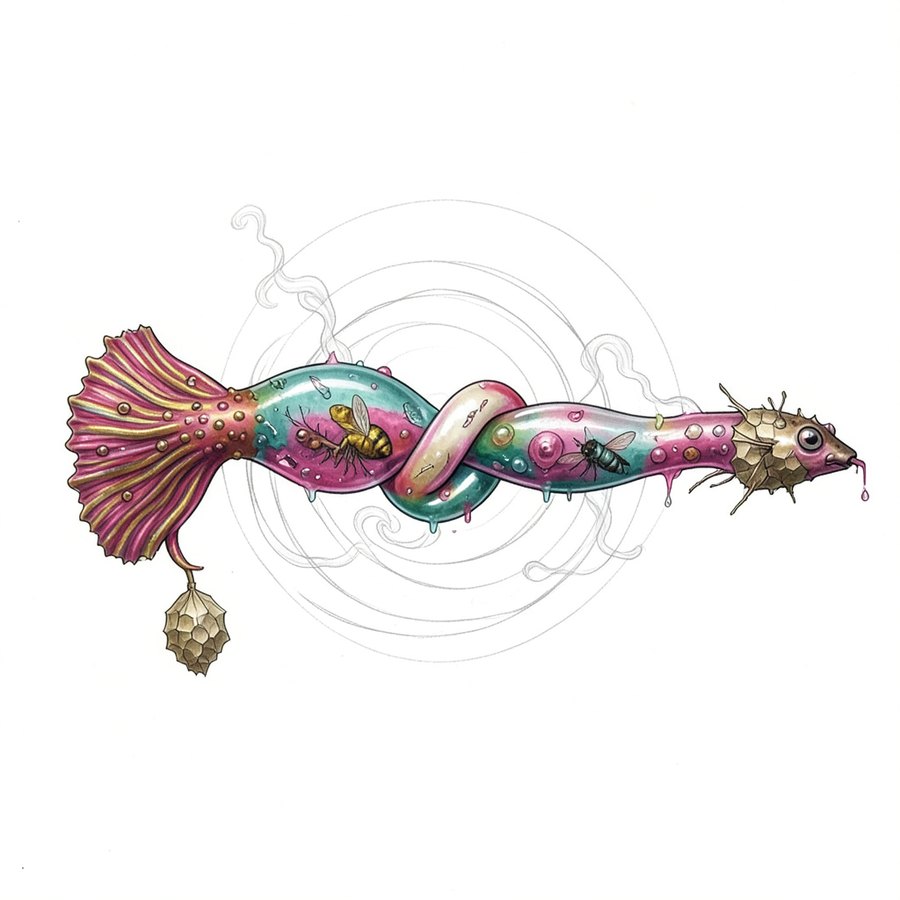
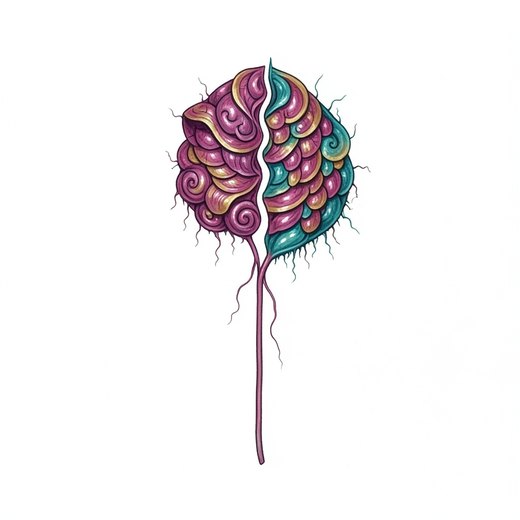
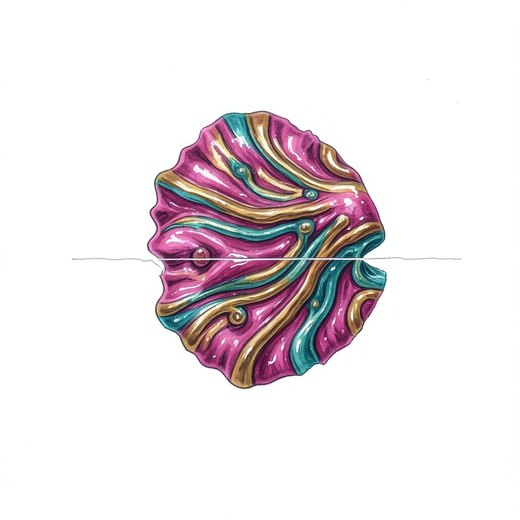
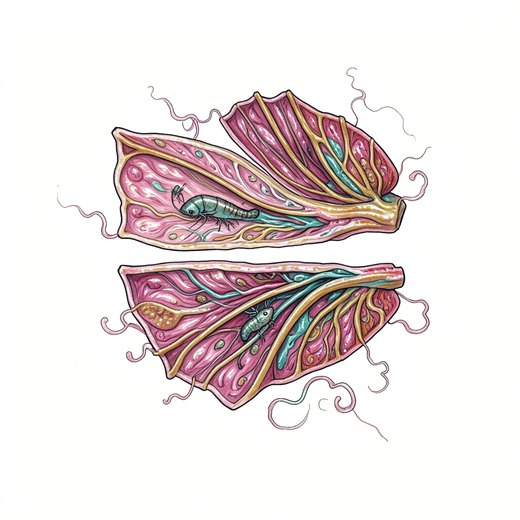
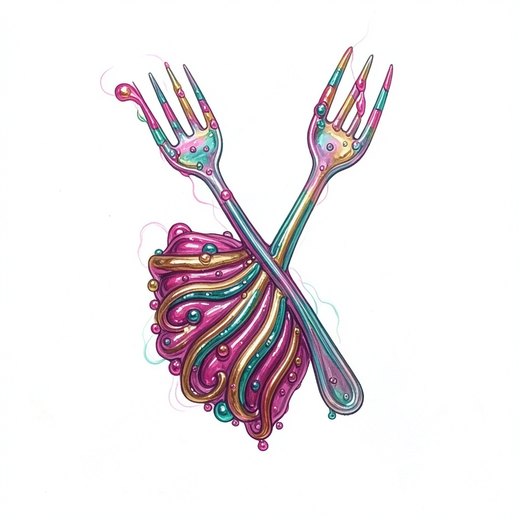
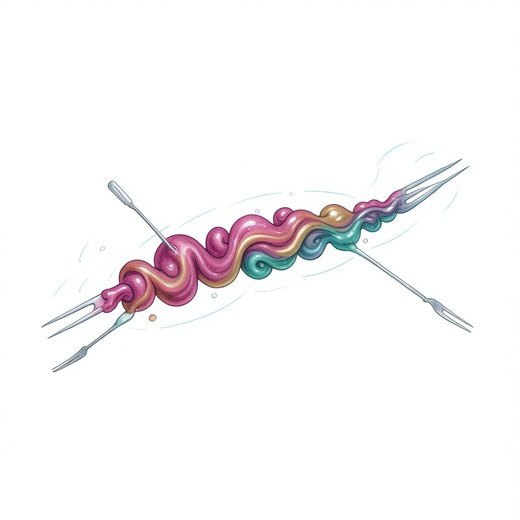
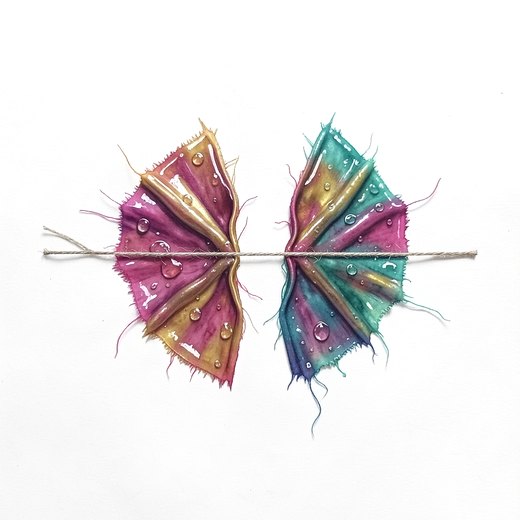
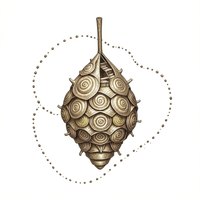
Plate XLVIII. Glossorizon divergens, the whole specimen.
Two peoples drifting apart one syllable at a time reach a moment after which they no longer understand each other; no one notices it being crossed, and it cannot be crossed back.
Two speeches part at a moment no one sees.
behavior A long body that slowly splits from its tail toward its head, the two halves still touching, then not.
provocation
Whom do you understand today whom your grandchildren's grandchildren will not?
Each draw is the being derived afresh by the current laws at another seed (laws §11); the chosen one leads (where they sit in the morphospace).
I Dissection
Each organ answers one question about the idea. The framed one, its boundary, is
the dominant organ: the being's class, the one the idea could not lose and stay itself.
Which premise, if it were false, would kill this idea?
Two peoples who once spoke alike drift apart one sound at a time, as two cups of the same water left in different rooms take on different temperatures, and somewhere along the drift lies a moment after which they no longer understand each other.3, 1
drawn as: essence · view: series
Fig. 2. Boundary
Shibboleth
❦ dominant organ
What sets it apart from what it is not, and how does it keep that distinction?
It is set apart from a dialect boundary by being crossed in time rather than in space, and by being invisible to those who cross it; it shows only when someone from either side can no longer follow the other.1
How does it turn what it takes in into what it gives out?
Each generation shifts a few sounds by the rules of its own side, a vowel lowered, an ending dropped, and the changes add up unnoticed, until the words the two sides share no longer sound alike enough to be recognised.2, 1
It gives two languages where there was one, Latin's daughters, the Norse of Iceland and of Norway, the English of two shores that still, for now, understand each other.1
drawn as: tincture · view: series
Fig. 6. Dispersal
Army and navy
What part of it travels into other minds, ideas and fields, and by what vector?
It travels with every migration that leaves one people on two sides of a sea, and in the saying that a language is a dialect with an army and a navy.4
drawn as: scent · view: at work
Fig. 7. Decay
Roof language
What can it not digest, where does it fail, and what does it leave behind for others?
It cannot be crossed back by speakers alone; only schooling, writing or a shared standard holds two sides together above it, and once it is crossed the shared past is kept only in written forms both can still read.1
drawn as: sediment · view: detached
II Meaning associations
descent membership food web resemblance or friction
Icelanders reading their medieval sagas, which Norwegians can no longer follow
Portuguese speakers understanding Spanish more easily than Spanish speakers understand Portuguese
Latin becoming French, Spanish and Romanian
a grandmother's dialect that her grandchildren no longer follow
If it is right
Between related speech communities, the share of words recognised falls with the time they have been apart, and understanding drops sharply below a level at which speakers report that they cannot follow.
Speakers on either side do not notice the crossing; they say that the others speak strangely long before they say that they cannot understand them.
Writing and schooling in a shared standard hold spoken varieties together long after their speakers stop understanding each other aloud, as with the spoken varieties of Chinese.
Fruits
study
Measuring the horizon
Record pairs of related dialects whose times of separation are known and test how well each side understands the other, to find whether understanding fades along a slope or falls at a threshold.1, 3
Is there a day on which two peoples stop understanding each other?
artwork
Letters across the water
An exhibition of letters written by emigrants to the family they left, generation after generation, read aloud by descendants on both sides of the sea, so that visitors hear the point where the two families stop understanding each other.
When did your family stop understanding its other half?
game
Drift
A cooperative game in which two teams begin with the same word list, change their sounds each round by drawn rules, and must keep passing messages across; the game ends at the horizon, and the score is how long they held it off.2
How long can two sides keep understanding each other while they drift?
bridge Both are about many small units and what their combining makes.
friction Entropy dissolves order blindly; Syllable remakes order with every beat, by rule.
tension If speech is order remade at every breath, what happens to it where too many breaths mix, or where two peoples stop sharing them?
questions neither parent could ask
What does speech sound like at its greatest disorder?
When do two drifting speeches become two languages?
Which part of speech is the last to wear away?
parasitism: What does Syllable's machinery make when it serves Entropy's premise?
candidate
emergence
depth
ground
distance
total
worn-names
2
1
2
1
6
The pet name, explained. The author's stars, 1.
beat-residue
2
2
2
1
7
Close to semantic satiation. The author's stars, 1.
local-wear
2
2
2
1
7
Dialectology read by loss. The author's stars, 2.
babelhum
3
3
3
2
11
Speech at its greatest disorder, grounded in the cocktail-party research; the name that rises is known, the hum as speech's heat death is not. The author's stars, 4.
tongue-horizon
3
3
3
2
11
Kept in the second attempt below. The author's stars, 4.
breathbought
2
2
1
2
7
A blend that has to be decoded. The author's stars, 2.
parasitism: What does Syllable's machinery make when it serves Entropy's premise across time?
candidate
emergence
depth
ground
distance
total
tongue-horizon
3
3
3
2
11
Mutual intelligibility is measured; the moment it is lost, unnoticed and not to be crossed back, has no name. The author's stars, 4.
Record 2026-10-26-entropy-x-syllable in lab/.
How it was drawn
its draw 1, a point in the morphospace (laws §8), drawn by flux-2-klein-4b.safetensors.
axis
value
from
book
humores
mutation
symmetry
concentric
Entropy
organization
chained
Entropy
silhouette
knot
Entropy
scale
microscopic
Entropy
proportion
swollen latent
Entropy
growth
intercalary
mutation
articulation
tethered latent
Entropy
openness
lattice latent
Entropy
skeleton
test latent
Entropy
locomotion
gliding latent
mutation
pattern
speckled latent
Entropy
coloration
plain latent
mutation
substance
smoke
mutation
surface
beaded
Entropy
palette
bismuth
mutation
luminosity
sheen
Entropy
transparency
translucent
Entropy
gesture
coils
Entropy
unity
aggregate latent
Entropy
modality
contingent
Entropy
causation
efficient latent
Entropy
determinacy
fraying latent
Entropy
fusion
mirrored
level
anomaly
scale clash
Entropy
graft
pipes
Entropy
technique
gouache
Entropy
viewpoint
motion
mutation
value
low key latent
mutation
balance
cantilevered
Entropy
density
intricate latent
Entropy
rhythm
unmarked latent
Entropy
saturation
unmarked latent
mutation
appendages
frills, cilia
mutation
anchor (body)
a cuttlefish, a fringed body whose skin ripples with moving bands of colour
Entropy
anchor (detail)
a paper wasp nest, hexagonal paper cells hanging from a single stalk
Syllable
Sources
Charlotte Gooskens, The contribution of linguistic factors to the intelligibility of closely related languages (Journal of Multilingual and Multicultural Development, 2007)
William Labov, Principles of Linguistic Change, volume 1, Internal Factors (1994)
Morris Swadesh, Towards greater accuracy in lexicostatistic dating (International Journal of American Linguistics, 1955)
Max Weinreich, who popularised the saying in YIVO Bleter (1945)